The Future is Tall: Why Hollywood is Embracing Vertical Storytelling

There was a time, not so long ago, when the entertainment industry looked at vertical video with a mix of confusion and disdain. It was viewed as the domain of dance challenges, influencer updates, and amateur skits. Serious filmmakers shot in landscape. Cinema was horizontal. The phone screen was an afterthought.
That era is officially over.
As we move into 2026, the landscape has shifted beneath our feet. Vertical dramas, once dismissed as a "niche fad" or a "guilty pleasure" have graduated. It is no longer just a scrappy outsider knocking on the door of the entertainment establishment. It kicked the door down, walked in, and sat at the head of the table.
For creative professionals, this is the most critical signal yet. When major studios, historic unions, and billion-dollar tech giants start realigning their strategies around a new format, it is not a trend. It is a paradigm shift.
This is the state of the union for vertical storytelling. And the state of the union is strong.
1. The Studios Have Entered the Chat
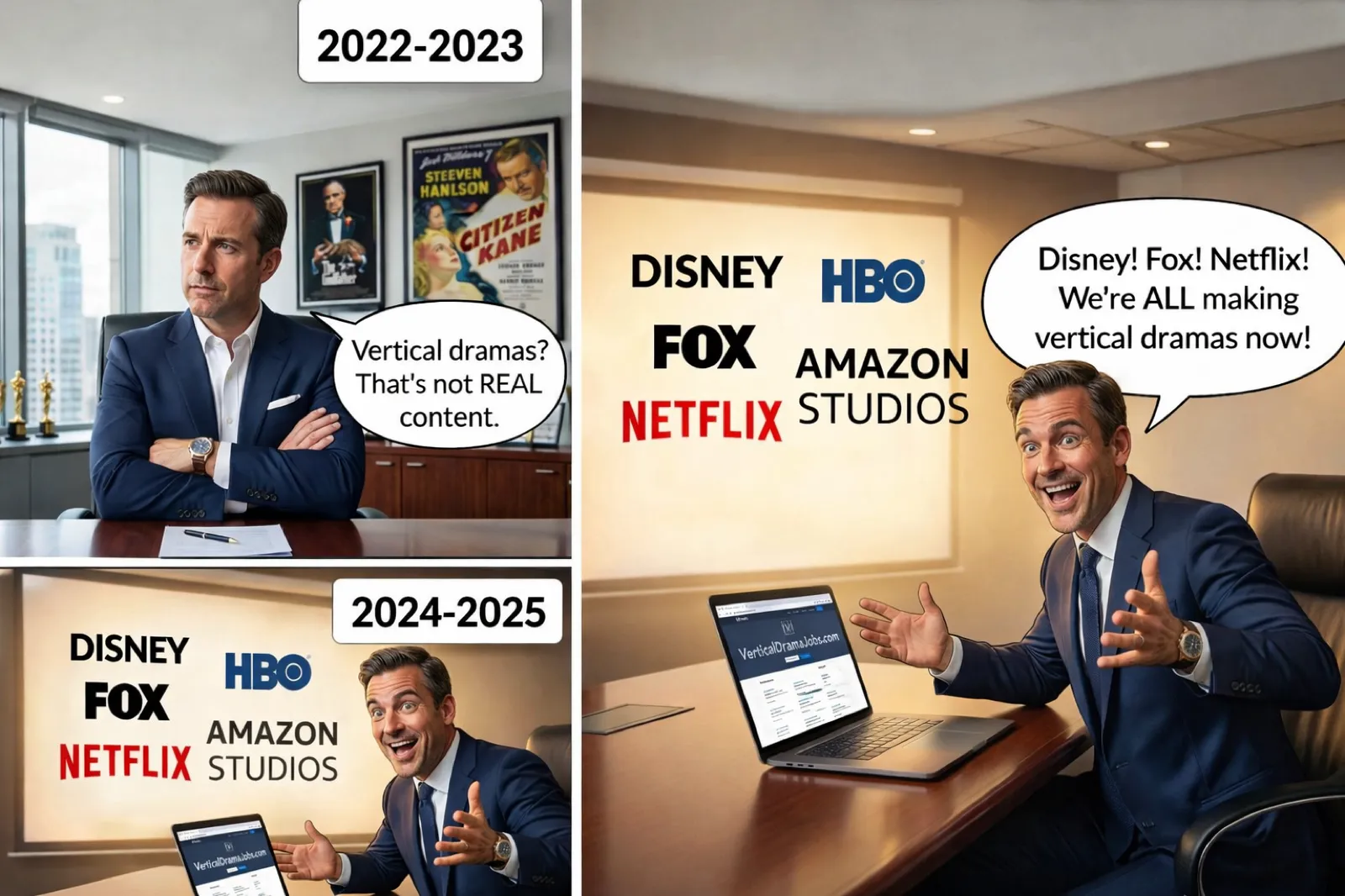
The most significant development of the last twelve months has been the aggressive entry of legacy Hollywood studios into the vertical space. For years, the market was dominated by agile, tech-first startups like ReelShort and DramaBox. But the "Big Five" studios have realized they cannot ignore an audience of billions who live their lives in portrait mode.
Fox Entertainment’s Massive Bet
Perhaps the loudest signal came in late 2025 when Fox Entertainment announced a massive equity stake in Holywater, the tech firm behind the hit app "My Drama." This was not a small experimental partnership. Fox committed to producing over 200 original vertical series including microdramas.
Think about that number. Two hundred series. That is a volume of production that traditional television cannot match. By leveraging their existing IP and deep bench of talent, Fox is validating the format as a primary revenue driver, not just a marketing tool.
The Disney Accelerator Seal of Approval
The House of Mouse, a company known for protecting its brand image and IP fiercely, has also made its move. In 2025, the Disney Accelerator program selected DramaBox, one of the world's leading vertical drama apps, as one of its cohort companies.
This mentorship signals a potential future where the "House of Mouse" begins to experiment with vertical formats for its massive library of characters. Furthermore, Disney+ has announced plans to integrate a vertical video feed directly into its streaming service in the US, acknowledging that users now expect a "feed-like" discovery experience even on premium platforms.1
Warner Bros. Discovery and the K-Drama Pipeline
Even as the industry consolidates with the massive Netflix and Warner Bros. Discovery merger reshaping the landscape in late 2025, the focus on mobile-first content has sharpened. Warner Bros. Discovery’s strategic partnership with CJ ENM to bring K-dramas (a genre that shares much of the fast-paced, emotional DNA of vertical dramas) to HBO Max highlights a broader shift toward high-engagement, serialized content that mimics the "addictive" nature of verticals.
2. The Numbers Do Not Lie

Why are these giants pivoting? Because the math is undeniable.
According to research from Omdia presented at MIPCOM, the microdrama sector generated an estimated $11 billion in global revenues in 2025. Other projections place the market potential even higher, forecasting it to top $16 billion by 2030.2
To put that in perspective, the vertical drama market is now generating revenue comparable to substantial chunks of the traditional box office. In China, where the trend originated, microdrama revenue has already surpassed the domestic theatrical box office.
The unit economics are also incredibly attractive for investors. A traditional TV pilot might cost $5 million to produce and fail to find an audience. A vertical series can be produced for $150,000 to $300,000.2 This allows studios to take more risks, test more concepts, and rely on data rather than gut instinct. If a show hits, the ROI is astronomical. If it misses, the loss is negligible.
3. Legitimization: Unions and Festivals
A new medium becomes a "real industry" when the institutions that protect and celebrate art begin to recognize it. That happened in earnest throughout 2024 and 2025.
The SAG-AFTRA Vertical Agreement
For a long time, vertical dramas operated in a gray area of non-union production. That changed when SAG-AFTRA introduced specific agreements for vertical and micro-budget productions [6].
This was a watershed moment. It meant that union actors, the top tier of talent in Hollywood could now work on these projects without risking their status. It provided safety standards, minimum rates, and a framework for professionalization. For producers, it opened the floodgates to a higher caliber of acting talent, instantly elevating the quality of the content.
The Festival Circuit Embraces the Vertical
You know the format has arrived when it shows up at the world's most prestigious film festivals.
- Sundance: The 2025 festival featured panels specifically discussing the impact of digital storytelling and the "impact lounge" fostering dialogue around new formats.
- SXSW: Known for being at the intersection of tech and film, SXSW 2025 featured extensive programming on the "creator economy" and the blurring lines between traditional TV and vertical series.
- Cannes: The festival has continued its partnership with TikTok, featuring the #TikTokShortFilm competition which celebrates vertical storytelling on the world's most glamorous stage.
Directors and writers are no longer hiding their vertical work. They are showcasing it.
4. The Creative Evolution: Beyond the "Trashy" Trope
Critics used to dismiss vertical dramas as low-quality soap operas about billionaires and werewolves. While those tropes are still popular (and profitable), the genre is rapidly diversifying.
We are seeing a surge in thrillers, mysteries, and historical dramas adapted for the vertical screen. The writing is getting sharper. The "hook" is becoming more sophisticated. Creators are learning how to use the vertical frame not just to show a talking head, but to create intimacy, tension, and claustrophobia in ways that landscape cinema cannot.3
Production quality has also skyrocketed. We are moving away from DSLR shoots in Airbnb living rooms to virtual and AI production stages in Los Angeles. Companies like ARwall and NEP Virtual Studios are providing LED volume technology that allows vertical productions to shoot in "Paris" or "Sci-Fi dystopias" without leaving California.4 This technology, once reserved for The Mandalorian, is now making vertical series look like million-dollar movies.
5. Why This is a Safe Bet for Your Career
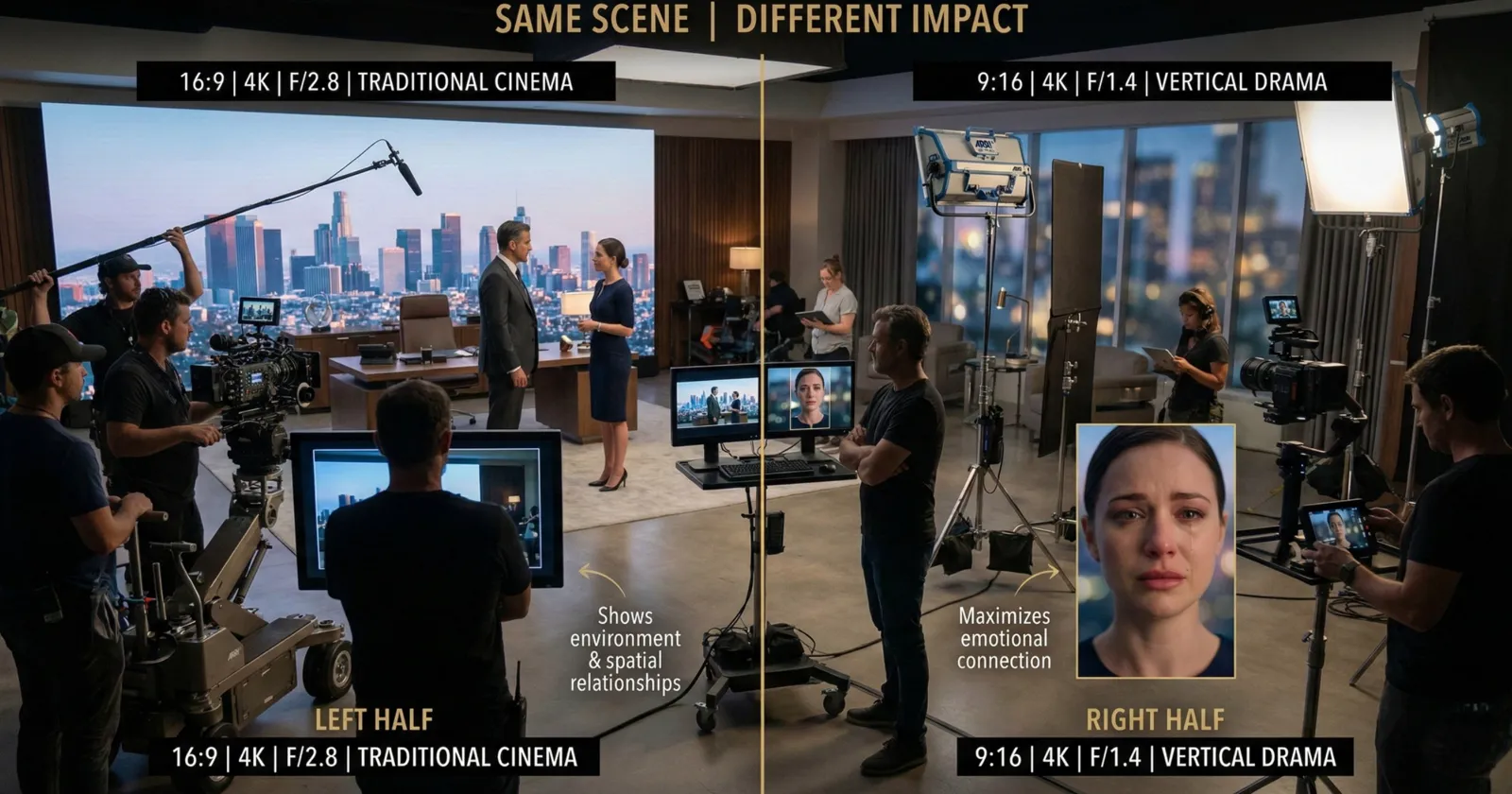
If you are an actor, writer, or crew member standing on the sidelines, you might be asking: "Is this a bubble?"
The evidence suggests it is not. It is a structural shift in consumption.
- Mobile-First is Permanent: We are not going back to a world where we leave our phones at home. As 5G improves and screens get better, the phone is the primary entertainment device for Gen Z and Alpha.
- The "In-Between" Moments: Vertical dramas solve a specific problem. They fill the "micro-boredom" gaps in our day ranging from the commute, the coffee line, and the bathroom break. Traditional TV cannot compete for those 3-minute slots.
- Global Portability: Vertical dramas travel better than almost any other format. A show produced in LA can be dubbed using AI and distributed instantly as novelas verticales to Latin American countries, to India's emerging vertical Bollywood market, across Africa's vertical Nollywood scene (centered in Nigeria), and throughout Europe and Southeast Asia. Platforms like DramaBox and ReelShort are seeing massive growth in these regions, creating a truly global job market for creators.5
Conclusion: The Screen Has Turned
The horizontal screen dominated the 20th century. The vertical screen is defining the 21st.
Mainstream Hollywood isn't just "dabbling" in vertical storytelling anymore; they are actively building the infrastructure for it. They are signing the checks, hiring the talent, and building the apps.
For the skeptics, the window to dismiss this as a fad has closed. For the visionaries, the window of opportunity is wide open. The industry is hiring. The budgets are increasing. And the audience is waiting.
The future of Hollywood is vertical. And it looks bright.
Ready to be part of the future? Register at VerticalDramaJobs.com to connect with the studios and production companies leading this revolution.
Works cited
- Disney+ takes on TikTok, Instagram with new short-form video feed, accessed January 10, 2026,
- Vertical Shorts Dramas Are an $8 Billion Business, Hollywood Is
- Top Virtual Production Companies in Los Angeles | 2025 Guide
- State of Short Drama Apps Overseas 2025 Report - InvestGame
- 'Soap opera on cocaine': how vertical dramas flipped Hollywood