The Untapped Opportunity in Verticals: The Male Audience

The Billion-Dollar Blind Spot
The vertical short drama industry just crossed $700 million in quarterly revenue. Let that number settle for a second. Two years ago, in Q1 of 2023, the entire global market generated $1.8 million. That is not a typo. The industry grew 400x in 24 months. There are now 950 million cumulative downloads across platforms like ReelShort, DramaBox, ShortMax, and dozens of others. This is one of the fastest entertainment format explosions in the history of mobile.
And it was built almost entirely for one gender.
Across the major platforms, the audience skews 70 to 80% female. 87.5% of all short drama ad spend targets women aged 25 to 44. Nearly 40% of ads target only women. The content is romance. The marketing is romance. The brand identity is romance. The industry found what works, and it optimized relentlessly for a single demographic.
Nobody is arguing that the strategy was wrong. It produced a $700 million quarter. The female romance audience built this industry from nothing. Full credit.
But I keep coming back to a question that the numbers can't answer on their own. Is the industry serving 70% of the addressable market? Or is it serving 100% of a market it accidentally narrowed to 70%?
Because the origin story of this format tells a very different tale than the one most English-speaking producers know.
Where It Actually Started
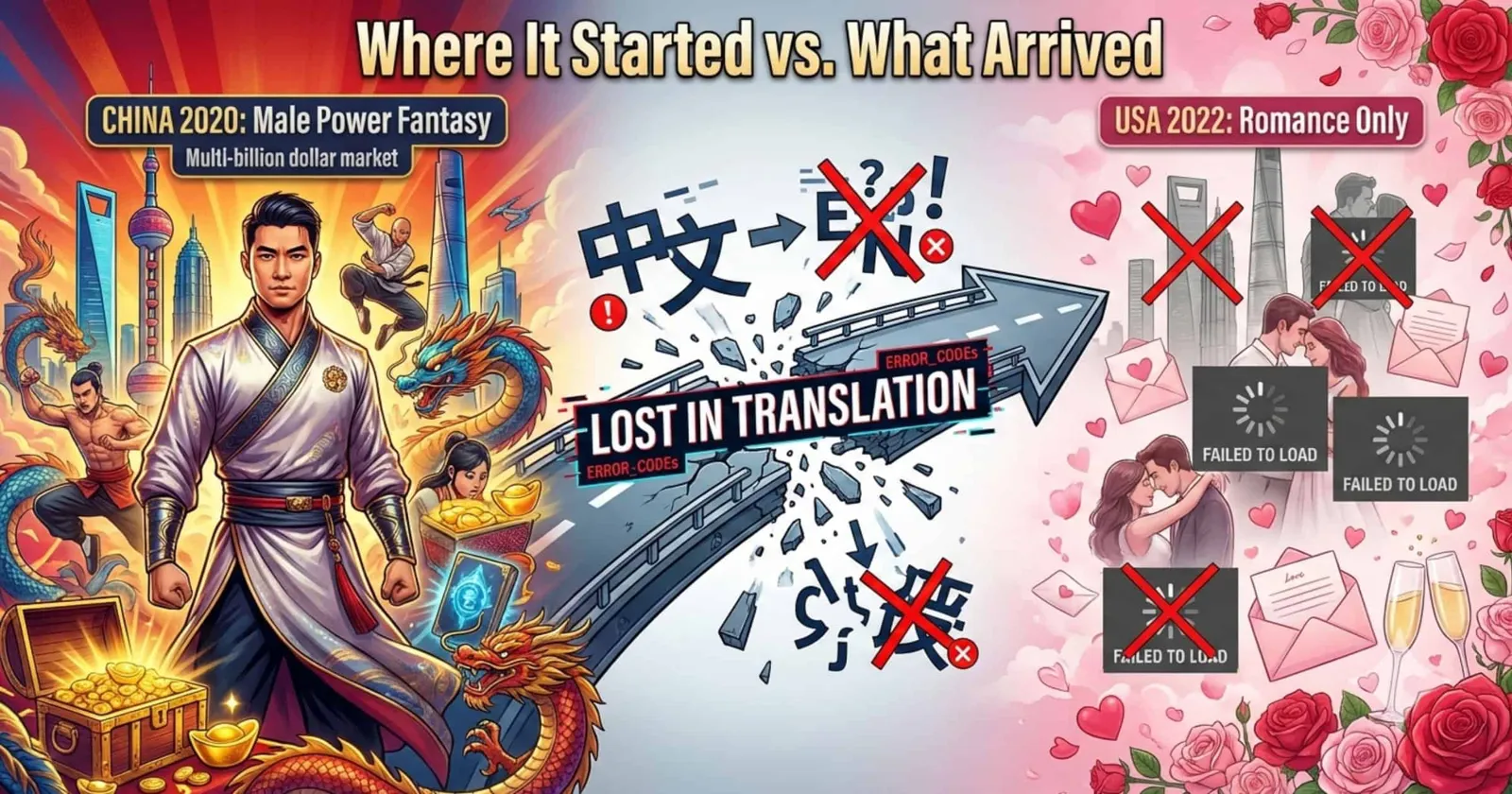
In China, where vertical short dramas (called duanju) originated, the format didn't start with romance. It started with men.
The foundational genre was called zhui xu. Son-in-law dramas. The setup: a man marries into his wife's family, a practice called matrilocal marriage that carries enormous social stigma in Chinese culture. The husband is mocked, dismissed, treated as less-than by the in-laws. Then comes the reveal. He's actually a secret billionaire. Or a martial arts grandmaster. Or an heir to a hidden dynasty. The power fantasy isn't about earning success. It's about revealing that you had it all along while everyone underestimated you.
The target audience was men over 40 in China's smaller cities. Producer Hou Chao described the appeal plainly: viewers feel satisfaction seeing protagonists winning women, wealth, status, and power. During COVID lockdowns in 2020 and 2021, the genre exploded. It became a multiplatform phenomenon adapted across web novels, short videos, and live-action micro-dramas. China's domestic micro-drama market grew into a multi-billion dollar industry, and male power fantasy content was the engine that started it.
Then someone tried to bring it to America. And that's where the story breaks.
The Translation That Failed
In August 2022, Crazy Maple Studio launched ReelShort in the United States. The initial strategy was straightforward: take what worked in China and translate it for English-speaking audiences. VP Nanya Peng later admitted the approach fell flat. They tried translating Chinese viral hits directly, but it didn't work as well as they'd hoped. The first ten months showed no significant growth.
Three things went wrong.
First, the zhui xu concept has no Western equivalent. The shame of matrilocal marriage, the specific family hierarchy dynamics, the Confucian filial piety that gives the revenge its emotional weight. None of that exists in American culture. You can translate the words. You can't translate the feeling.
Second, content norms clashed violently. Chinese male-targeted dramas frequently included scenes of physical intimidation toward women, a trope called bi dong (wall slam), which is legally and culturally classified as harassment or assault in the West. Extensive editing was required, and what remained often lost the dramatic tension the original relied on.
Third, and most importantly, the male power fantasy itself runs on different fuel in different cultures. In China, male success in these dramas is about revelation. The protagonist was always powerful. He was just hiding it. In Western storytelling, male success is about demonstration. The protagonist earns it through visible action, competence, and grit. Rocky doesn't reveal he was secretly a champion all along. He trains, bleeds, and fights his way to the top. Different dramatic engines entirely.
What DID translate was romance. ReelShort's breakthrough hit, Fated to My Forbidden Alpha, took the Chinese CEO-romance formula and reimagined it through Western werewolf clan mythology. The emotional beats of desire, jealousy, forbidden attraction, and eventual union travel across cultures far more easily than status revenge does. Romance doesn't require cultural context. Longing is universal.
So the industry followed the path that worked. Romance localized easily. Male power fantasy required genuine cultural adaptation that nobody invested in. And a pattern locked into place that hasn't been seriously challenged since.
The Data Nobody Wants to Talk About

If the male audience for vertical drama didn't exist, the conversation would end here. Romance works. Women pay. Optimize. Move on.
But the data from every adjacent platform tells a completely different story.
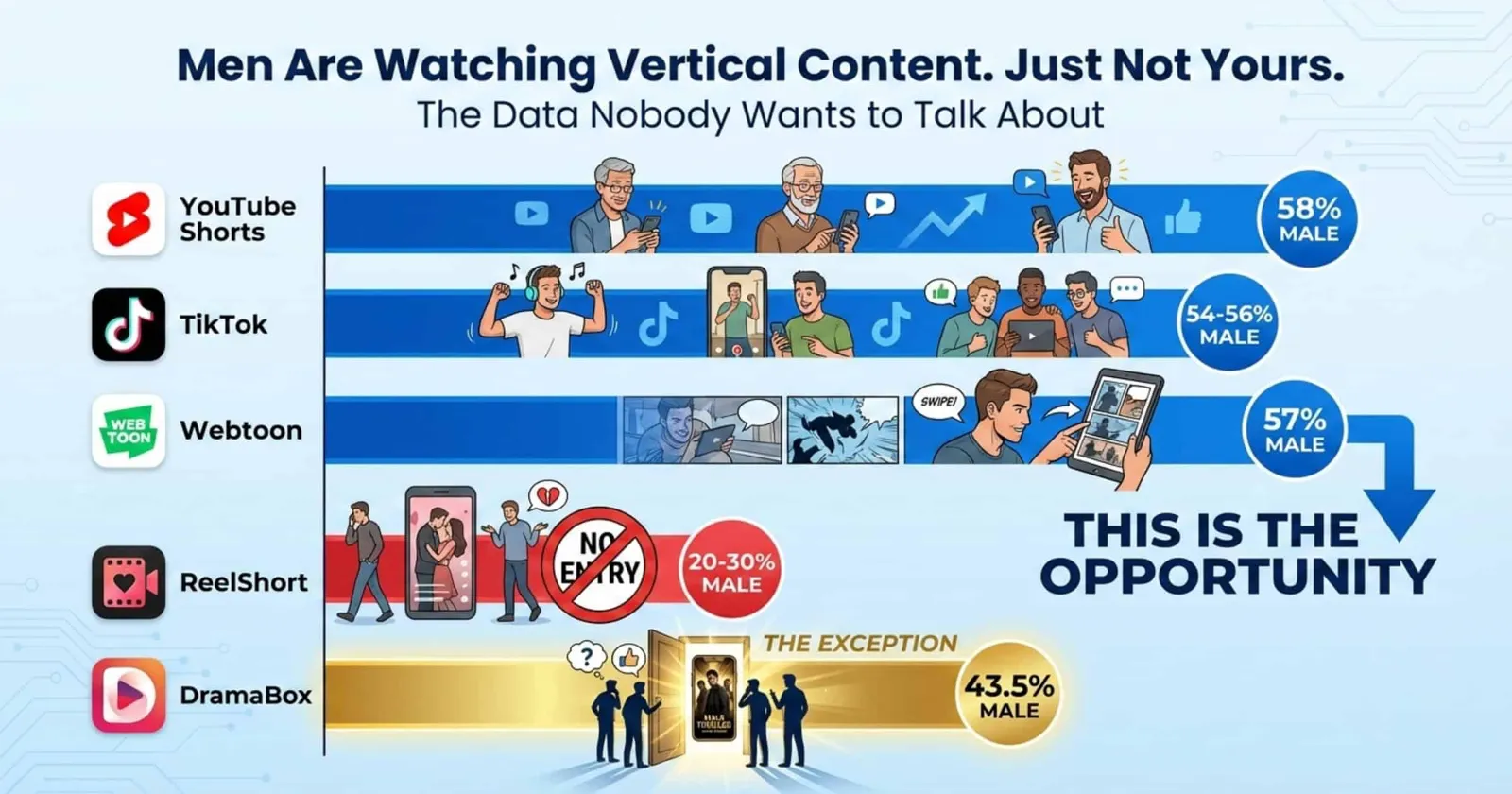
YouTube Shorts' audience is 58% male, with the highest engagement rate (5.91%) among all short-form platforms. TikTok is 54 to 56% male globally. Webtoon's readership is 57% male. Every major short-form vertical content platform skews male. Every single one. Except the platforms that only make romance.
ReelShort? 70 to 80% female.
That gap is the entire argument. Men are consuming short-form vertical content at massive scale on YouTube Shorts, TikTok, and Webtoon. They're paying for serialized vertical storytelling on Webtoon, buying chapters week to week. They're not avoiding the format. They're avoiding the content.
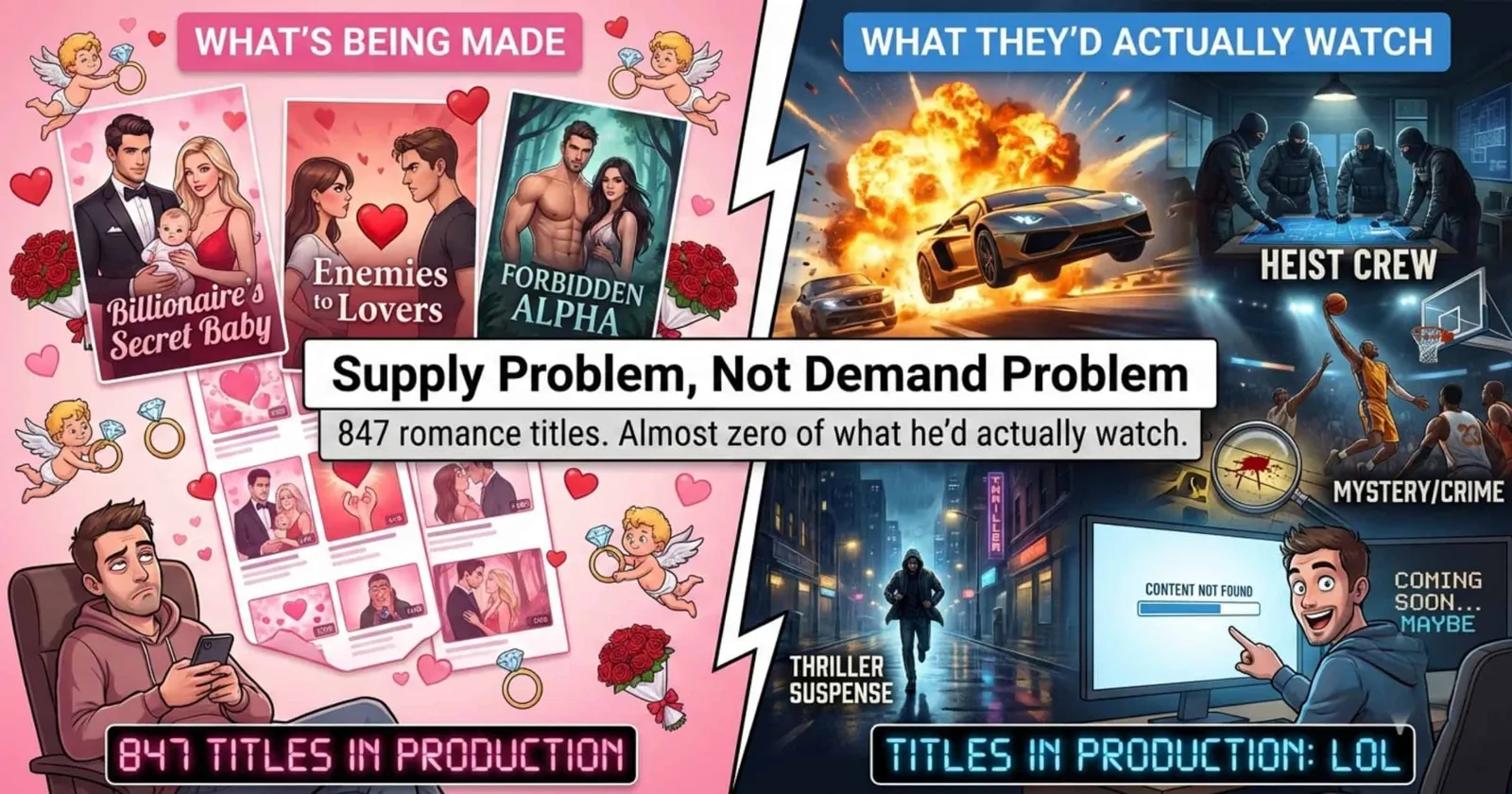
This is not a demand problem. It's a supply problem.
The DramaBox Exception
If I had to point to one data point that should change this industry's assumptions, it would be this: DramaBox's user base is 43.5% male. That's the highest male ratio among any major vertical drama platform. And it didn't happen by accident.
DramaBox, owned by Storymatrix (a subsidiary of Chinese tech firm Zhuolu), deliberately invested in male-oriented content. Action titles. Revenge dramas. Translated Chinese power fantasies that were adapted rather than just subtitled. The result is a gender split dramatically closer to parity than any competitor. And the platform is profitable. $10 million in net profit in 2024. Revenue of $450 million. Selected for Disney's 2025 Accelerator Program. This is not a marginal player making a niche bet. This is the second-largest platform in the space proving that male audiences convert when you actually serve them.
Over on ReelShort, the evidence hides in a corner of the app most people never explore. The platform maintains a category called Male Movies with over 200 titles across 24 pages. The top performer, a power fantasy called Move Aside! I'm the Final Boss, has accumulated over 305 million views. That's comparable to their best romance content. Another title, Money, Guns, and a Merry Christmas, hit 271 million views and according to platform data, attracted over a million paying users in its first three months.
GoodShort went further and created an explicit Fantasy-Male content category. The first platform to openly segment by gender.
When male content exists, it performs. The industry just hasn't built enough of it to notice.
The Gaming Overlap Nobody's Connecting

Here's where the opportunity gets harder to ignore. According to Sensor Tower's analysis of app usage overlap, over 30% of the top 100 apps used by short drama audiences in the United States are games. In Brazil, that figure exceeds 50%.
Think about what that means. The people already watching vertical dramas are also heavy gamers. And gaming audiences skew male. The Venn diagram overlap between potential male short drama viewers and existing mobile gamers is enormous. These aren't separate audiences that need to be discovered and acquired from scratch. They're adjacent audiences separated by a content gap.
The gaming industry knows this. Krafton, the company behind PUBG, invested $90 million into Vigloo, a vertical drama platform. Nazara Technologies invested in ReelSaga. These aren't entertainment companies dabbling in games. They're gaming companies entering entertainment. And they bring something the incumbent drama platforms don't have: existing male audiences, user acquisition expertise built around male demographics, and monetization sophistication (battle passes, progression systems, microtransactions) that maps cleanly onto the episode-unlock paywall model.
The male vertical drama viewer already exists. He's just playing games instead of watching stories. Because nobody's given him a story worth watching.
The Catch-22 (And Why It's About to Break)
I understand why the industry hasn't moved yet. The logic is clean, and it's been rational up to this point.
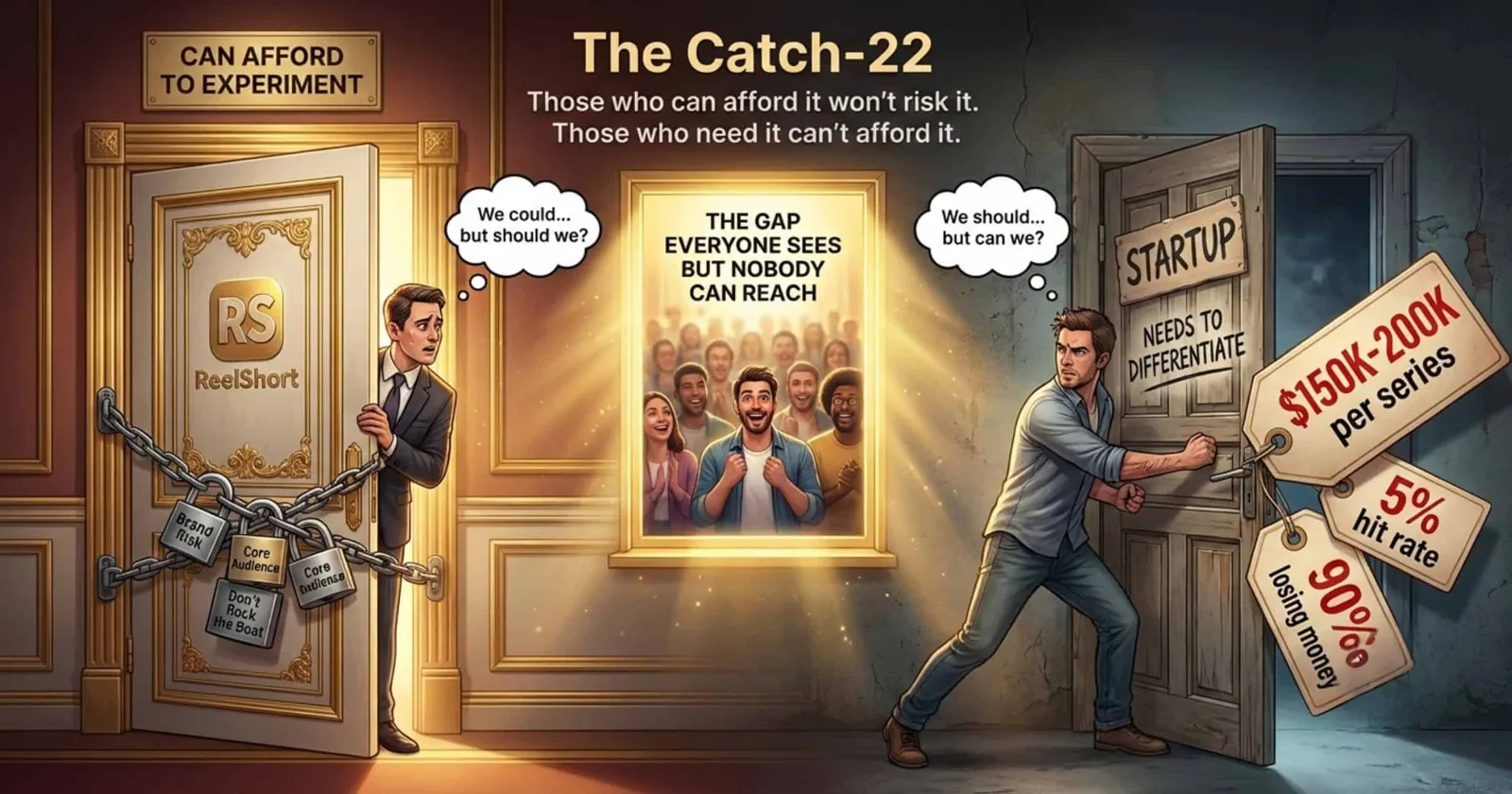
The dominant players, ReelShort and DramaBox, have built massive female audiences. ReelShort alone has $490 million in cumulative revenue and 50 million monthly active users. Their brands are synonymous with romance. Their entire operational stack, from casting to production to marketing to ad creative, is optimized for female viewers. Pivoting isn't a content decision. It's an operational overhaul.
ReelShort CEO Joey Jia has been transparent about the priority. In an interview with TIME, he said they're focusing on the female cohort, offering romantic stories and high-drama stories. But he also committed to building mystery, thriller, action, and other content types for different cohorts. The intent is there. The urgency isn't.
Smaller platforms can't afford to take the swing. Production costs run $150,000 to $200,000 per localized series, and marketing budgets often exceed production. With only a 5% hit rate, content experimentation is lethal for underfunded players. Industry analysts estimate that 90 to 95% of producers are currently losing money, up from 80% just a year ago. When survival depends on copying what works, nobody experiments with what might.
That's the catch-22. The companies that can afford to experiment won't risk disrupting their core audience. The companies that need differentiation can't afford the cost of finding it.
So nothing changes. Until the math changes.
The Math Is Changing

There are now over 237 short drama apps competing in the overseas market. A year ago, that number was around 60. They're all fighting for the same audience, with the same content archetypes, through the same ad channels, using the same cliffhanger formulas. The female romance space isn't just crowded. It's approaching saturation.
When the dominant playbook stops producing outsized returns, capital looks for new markets. That's not a prediction. It's a pattern that repeats across every entertainment cycle. And the signals are already visible.
GammaTime raised $14 million, backed by Kim Kardashian and Kris Jenner, and positioned itself around suspense thriller and true crime. Not romance. That's a deliberate genre-first bet on underserved audiences. ByteDance launched PineDrama in the U.S. and Brazil, bringing TikTok's recommendation algorithm and its majority-male audience data to the vertical drama space. DashReels raised $13 million in India and hit 5 million downloads in its first month. Gaming companies like Krafton are investing at scale.
The new entrants aren't copying the romance playbook. They're looking for the gap. And the gap is male.
Who Moves First
DramaBox is the frontrunner. They already have 43.5% male. They're profitable. They have Disney's institutional backing. They're actively developing male genres, with executives Kelly Tang and Christianne Cruz signaling genre expansion in their Ankler interview. Their brand isn't locked to romance the way ReelShort's is. They have room to maneuver.
ReelShort has the resources but the brand constraint. $490 million in cumulative revenue means they can fund any experiment they want. But their audience expects romance. A sub-brand strategy could work. A genre expansion under the same brand risks confusing or alienating the core audience that built the business.
The dark horse is the gaming companies. Krafton's $90 million in Vigloo isn't pocket change. Gaming companies bring male-skewing audiences, UA infrastructure built for acquiring male users, and monetization frameworks (battle passes, progression mechanics, tiered subscriptions) that the drama platforms haven't explored. If a gaming company launches a vertical drama product purpose-built for men, the incumbent platforms won't be competing on content alone. They'll be competing against an entire acquisition and retention machine designed for a different demographic.
And the wildcards are the new entrants who build from scratch without legacy audiences to protect. No brand to dilute. No operations to reconfigure. Pure focus on the gap. GammaTime's thriller positioning is the clearest example. They're not trying to be the next ReelShort. They're trying to be the first something else.
What History Tells Us

This has happened before in other formats.
Podcasting started at roughly 70% male listenership. The industry assumed podcasts were for men. Then Serial launched in 2014, a true crime series that captivated female listeners, and the entire medium shifted toward gender parity. One breakout hit in an underserved genre proved the audience existed. Within a few years, true crime, wellness, and narrative storytelling podcasts transformed podcasting demographics entirely. Today the split is nearly 50/50.
Gaming tells the reverse story. For decades, gaming was considered a male activity. Then mobile gaming broke accessibility barriers, and women entered the market in force. Today, women comprise 46 to 48% of U.S. gamers. The platform change enabled the audience change.
Vertical drama is waiting for its Serial moment. One breakout male-focused hit that proves the data. One series that goes viral with men the way Fated to My Forbidden Alpha went viral with women. When that happens, the industry won't need persuading. The economics will do the talking.
The Closing Argument

The male vertical drama audience isn't hypothetical. The data from DramaBox's 43.5% male split, from Webtoon's 57% male readership, from YouTube Shorts' 58% male viewership, from 305 million views on ReelShort's top male title, from the 30 to 50% gaming overlap in short drama users' app portfolios proves demand. The audience exists. They're spending time and money on adjacent platforms. They're waiting.
The gap between Webtoon's 57% male readership and ReelShort's 20 to 30% male audience represents a multi-billion dollar opportunity. At the current market scale of $700 million quarterly, even closing that gap by a fraction, even capturing 20 to 30% incremental male revenue, would mean $140 to $210 million per quarter in new revenue. Not cannibalized. Additive.
All it takes is a handful of genuine male-focused hits to unlock the conversion data. What genres work. What cliffhanger structures make men tap unlock. What price points convert. What marketing language acquires male users efficiently. That data doesn't exist yet because the experiments haven't been run. But the experiments are coming. Saturation in the romance space will force them.
When that data arrives, we won't see cautious experimentation.
We'll see Vertical Gold Rush 2.0.
And this time, it won't be romance-led.
Which platform moves first? What male genre breaks through? Drop your prediction in the comments.
Vertical Film School
If this changed how you think about the vertical drama market, share it with someone building in this space.
#verticalfilmschool #verticaldrama #shortdrama #reelshort #dramabox #maleaudience #thoughtleadership
VerticalDramaJobs.com - Where Proven Archetypes Meet High-Volume Opportunity.