No. 4 · Week of November 25, 2026
TikTok bets on an 81-episode union musical
Plus our Black Friday bundle, day three of the Summit, brands paying for whole shows and the jobs open now.

We tracked more than 80 vertical drama stories from November 19 to November 25. Here are the ones that matter, plus who hired, from the studio career pages we watch every day.
The 30-second version
- TikTok made a musical microdrama with a union cast and crew. All 81 episodes land December 21.
- Macy Gray will put out her next album inside a ReelShort series.
- Crocs, Toyota and Superdrug each paid for a show of their own.
- Drama apps keep gaining US viewers, but the money spent inside them is falling.
- Industry leaders want to stop calling it micro drama. Vertical TV is the front-runner.
- Vote on where Micro Drama Summit 3 meets in person in 2027.
- Our Black Friday bundle opens Friday: both Summits on replay plus 3 months of Pro for $80.
- Day three of the Micro Drama Summit covered getting paid for AI series, keeping viewers watching, the over-65 audience and AI filmmaking.
Black Friday starts Friday
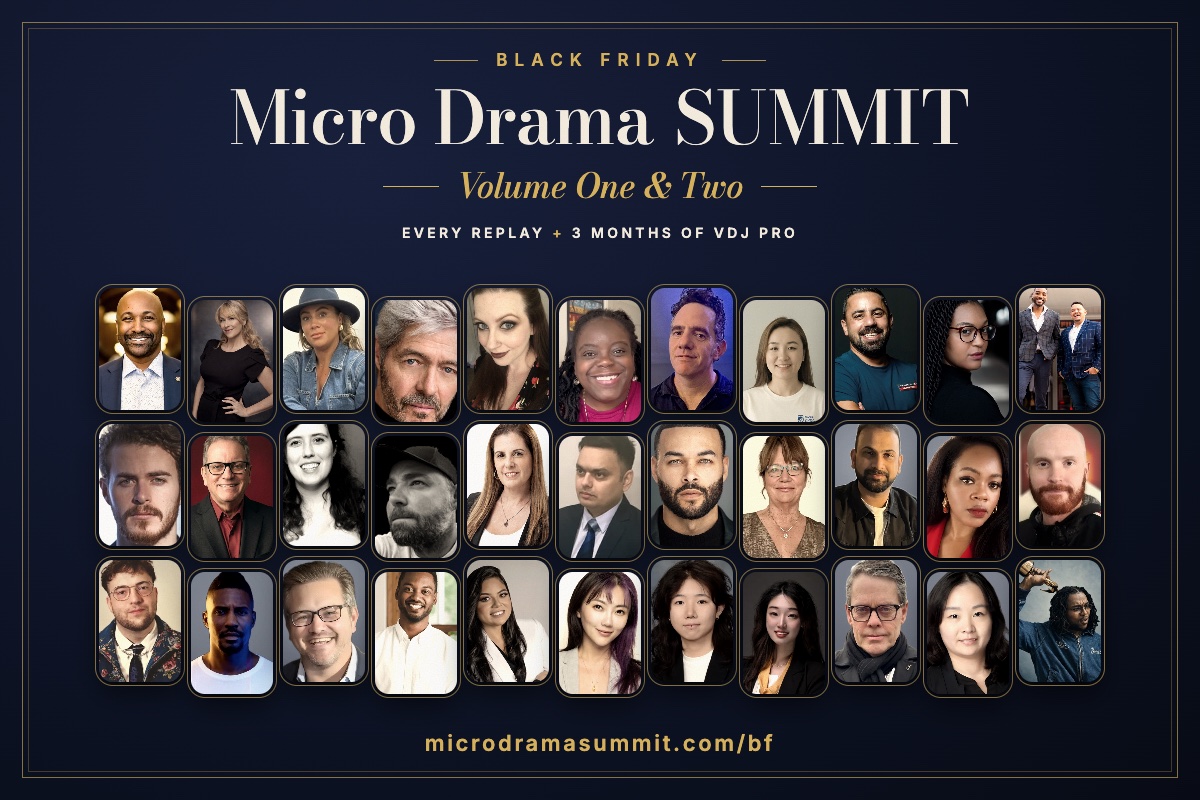
We've never done this one before. From Friday, November 27, through Monday, November 30, you can get both Micro Drama Summits in one bundle for $80. That's every talk from Volume One in June and Volume Two in November, 31 in all, with a full year of access, plus 3 months of Vertical Drama Jobs Pro on us. Do the math: about $2.42 per speaker, or 22 cents a day for the year.
Volume Two alone costs $107, so the bundle is cheaper than one Summit.
Already have one Summit? Get just the other one for $50 through Monday. The 3 months of Pro only comes with the $80 bundle.
Only want the jobs? Use code BLACKFRIDAY on Pro monthly and pay $15 a month for your first 3 months instead of $25. Cancel anytime.
| Get both Summits for $80 |
Micro Drama Summit 3: pick the city
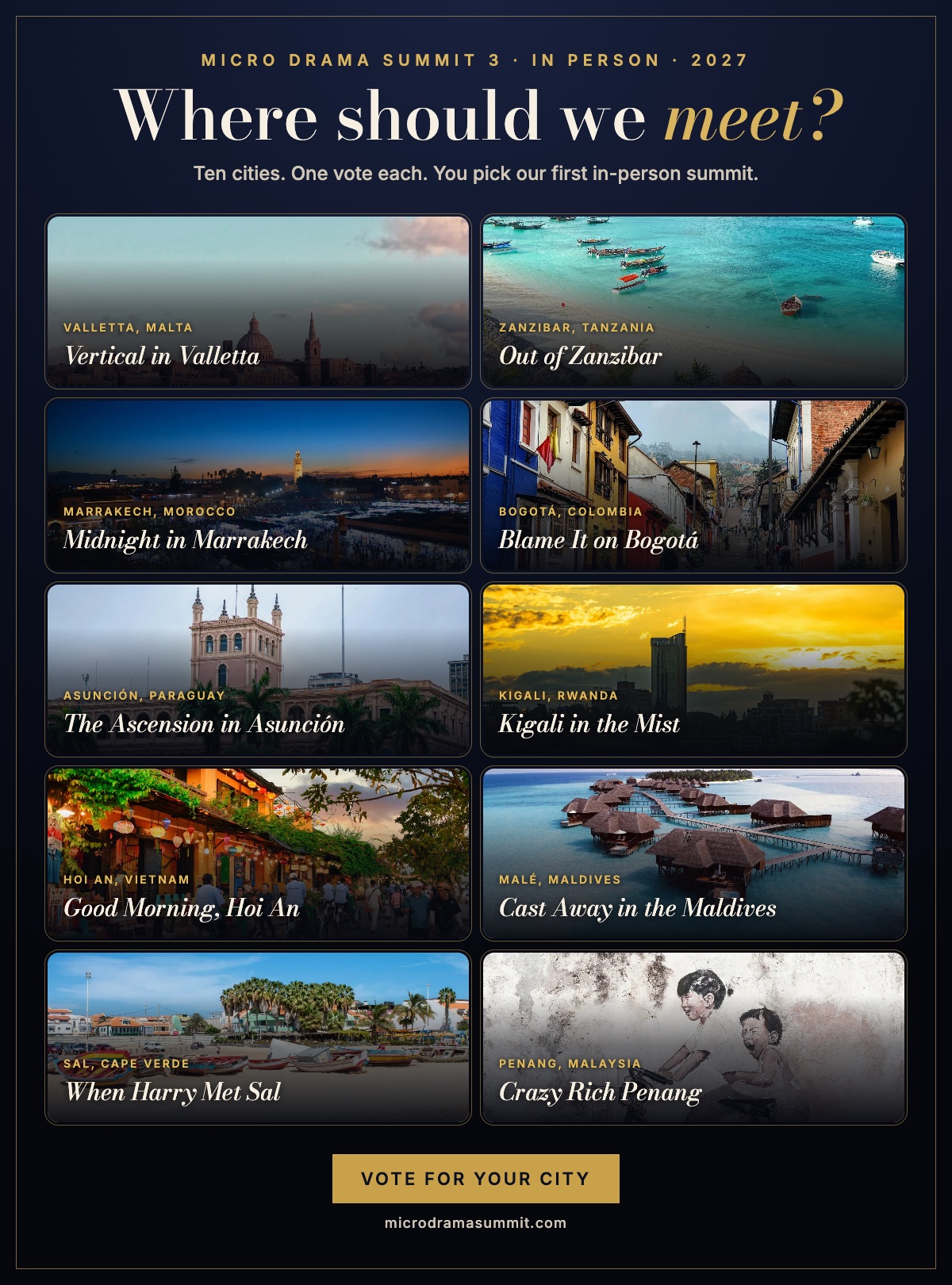
Our first in-person summit happens in 2027, and you get a say in where. Ten cities made the list, from Valletta to Penang. Anyone can vote, one vote per email, and you can write in a city we missed.
| Vote for the city |
Watched the Summit, or read this paper every week? Tell us what you think in a couple of minutes. The best ones go on the site with your name and title. Share yours here.
Stop calling it micro drama?
A naming fight took over LinkedIn this week. Jeff Clanagan, president and chief distribution officer of HARTBEAT, asked everyone to stop saying "microdramas."
His point: micro drama is one genre, and calling the whole format after it is like calling all of 1955 TV "soap operas." "Microdrama is a genre. Vertical TV is the format."
He thinks free, ad-supported series will win in the US over paying to unlock every cliffhanger, and he told producers to own their IP. His post drew 139 reactions and 48 comments.
The same day, media analyst Evan Shapiro put out a report he called Microdramas Are a Tiny Part of the Story. He also says vertical is a format, not a genre, and he doubts the pay-per-episode apps can last, pointing to how much ReelShort spends on Meta ads. His call: 2027 is the year Vertical TV goes mainstream.
Thom Woodley of Hudson Vertical agreed micro drama is a small slice of something bigger and uses "vertical narrative." A week earlier, Ian Schafer of Ensemble made the genre versus format case in a short video and went with "microseries."
The comments threw in more names: mobile first, vertical sitcoms and micro-entertainment, that last one from Johny Duval, who spoke at the Summit this month. Not everyone agrees. One commenter argued micro drama names a business model, not just a genre.
Whatever name wins, just give us an hour's notice so we can snag the domain and change our name.
Day three at the Micro Drama Summit
The Summit's last day ran on November 13 with four sessions. Every speaker has short clips on the Summit site, and the full talks are on replay.

Shu Dai: four ways to get paid for an AI series
Shu is CEO and co-founder of Gleam Media Studios. She sees four ways to make money from an AI drama: drama apps, TikTok, YouTube and selling the script.
Drama apps pay in two rounds. First comes a joint premiere on five apps with money up front and a 50-50 revenue split. After 30 days the show goes to more apps on revenue share alone.
Her studio's Farewell My Mafia Boss Lover got more than $20,000 up front across five apps, plus half the profit. Her shows cost about $10,000 each to make, so when the upfront money covers the budget, the revenue share is extra.
TikTok and YouTube pay nothing up front. In September, 59 AI dramas on TikTok split $1.16 million. Watch the clips
Emma Wang: the script decides the money
Emma, co-founder of Gleam Script Center, shared the session with Shu. She played two first episodes side by side. One had almost 90,000 saves, and she said it made more than $100,000 in a month. The other had 3,000.
Viewers want what she calls an effortless thrill, with happiness, sadness, anxiety and anger all inside one minute. Keep the hero relatable and the story easy to follow.
If you've finished a series and want to sell it, send the first three episodes for feedback, because those matter most. Thrillers, rom-coms, superpowers and stories where a choice changes the ending are working right now. Watch the clips
Dr Charles Kriel: keeping viewers is a writing job
Charles founded Screenburn. Viewers leave in three places, he said: the first three seconds of an episode, an ending that wraps the story up, and the paywall. Across the more than 100,000 series the CherryBowl catalog tracks, the typical ReelShort show puts its paywall after episode 10.
His five rules for Monday morning are to open inside the scene, change one thing per episode, end every episode on an open question, put a big hook every fifth episode and save the climax for the last few.
Writers get roughly $2,000 to $5,000 for a microdrama series, he said in the Q&A. "You have to be faster than the speed of the thumb." Watch the clips
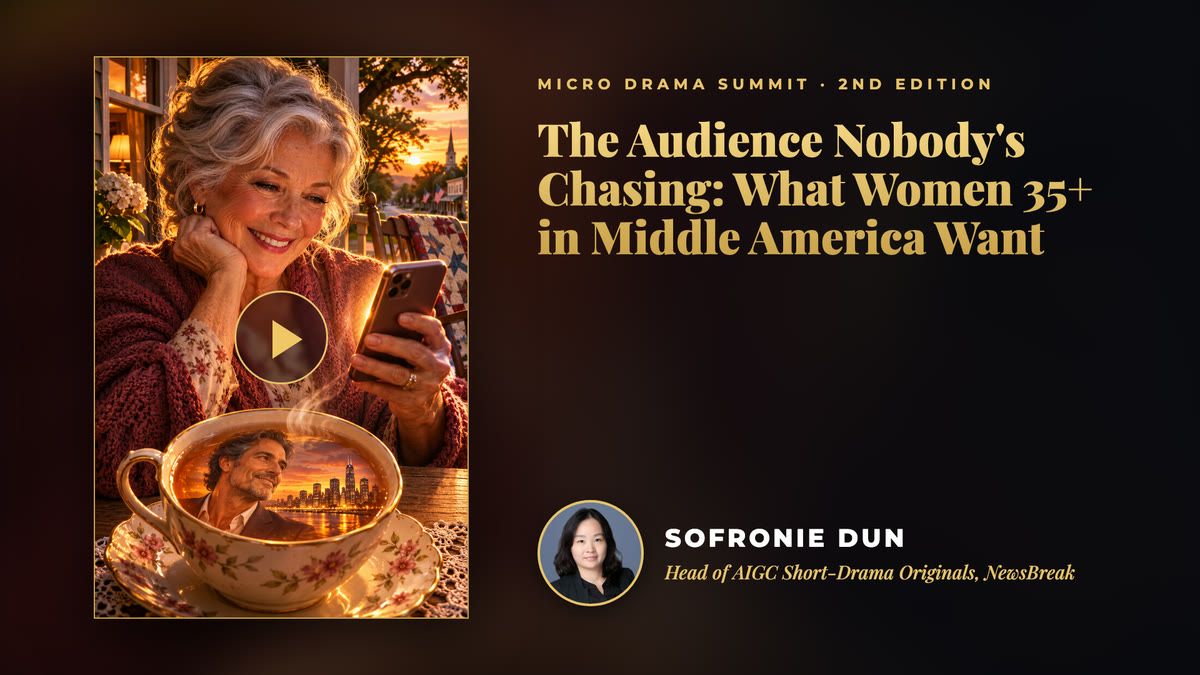
Sofronie Dun: the over-65 viewer
Sofronie heads AI short-drama originals at NewsBreak, a local news app with about 40 million monthly users. About 45% of its drama viewers are over 65, though that group is only about a quarter of its users. They watch 28 episodes a month.
Give them more free episodes, she said. With 10 free, people are hooked by the time they reach the paywall. With five, they may not be.
Stories about family, health and grandchildren work, and so do nostalgia and romance mixed with crime or suspense. Creators on NewsBreak's Drama Center keep 75% of net revenue until January 2027, when it moves to 50-50. Watch the clips
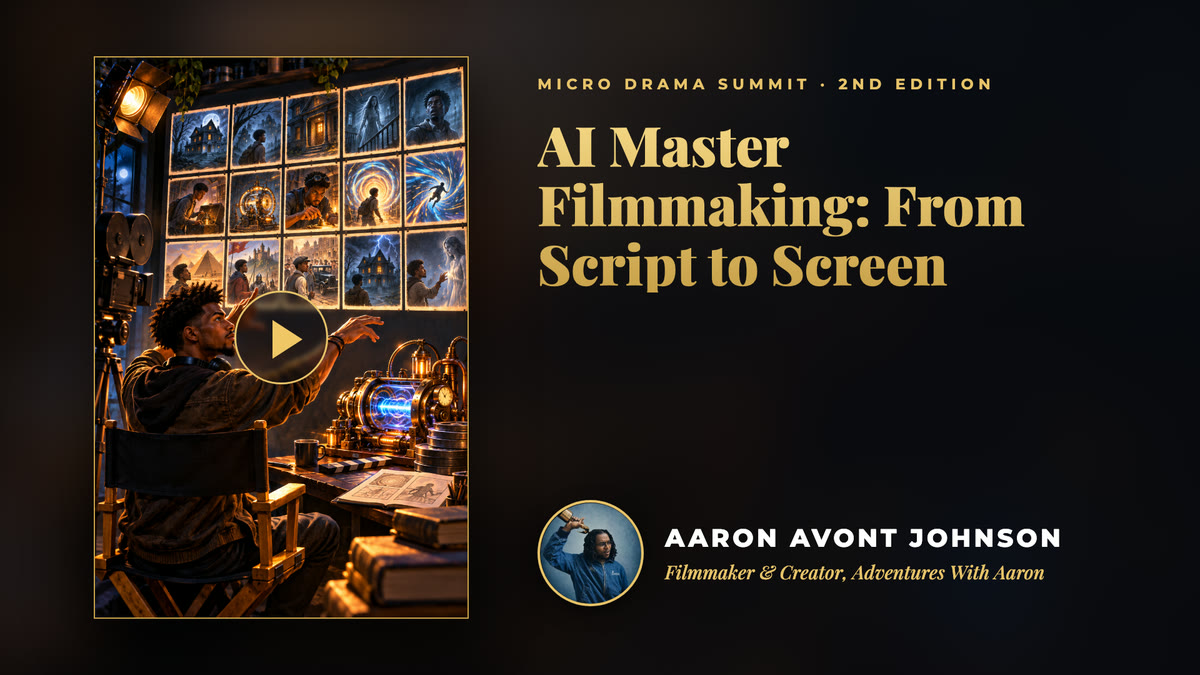
Aaron Avont Johnson: what one AI episode costs
Aaron makes the AI series Adventures With Aaron. Each 15-minute episode costs him about $700 to $800, which covers Higgsfield credits, a music subscription and upscaling.
To save money, generate at 720p and upscale at the end with Topaz. A 4K clip can burn 200 to 300 credits, against about 68 at 720p.
Before you generate anything, make a character sheet with four angles and a storyboard of each location, so the AI doesn't move a wall or swap a pair of earrings between shots.
A spec ad he made on his own is how he landed a paid commercial. "The tools are literally only going to do a certain percentage of the work." Watch the clips
All five of these talks, plus every Volume One talk, are in our Black Friday bundle for $80 from Friday through Monday.
|
Micro Drama Summit · Volume Two Missed the Summit? Every session is on replay. Every talk from the people making and hiring in vertical drama. 13 sessions for $107 · Watch for a full year.
|
Who hired this week
We added 45 jobs from 20 companies this week. Of those, 24 were creative and content roles. The rest were tech, sales and ops jobs at the same companies.
The busiest studio posted 7 of them, and 14 more posted 1 to 3 each. Pro members see which studios are hiring.
By role: 7 AI artist and AI filmmaker, 4 producing, 4 content and business, 4 acting, 3 writing.
Jobs open now
- ASO Manager, CandyJar (Inkitt), remote, $60,000 to $90,000 a year.
- Early Adopter & Product Builder Intern, Creative AI, OpenArt, remote, $40 to $50 an hour.
- DP / Producer, Story, San Francisco, $125,000 to $150,000 a year.
- Video Editor, Dolphin (contract), Eloelo Group (StoryTV).
- Video Editor, Spanish Content, Pocket FM, remote.
- Micro Drama Writer, Kuku (Kuku TV), Jaipur.
- Content Producer, Kuku (Kuku TV), Bengaluru.
More in writer jobs, acting jobs, production jobs, business jobs, remote jobs and all jobs.
Another 179 creative jobs are in their first 30 days, when only Pro members see the company and can apply. A few of them:
- A remote AI artist and AI filmmaker role paying $60,000 to $150,000 a year.
- An acting role in Mumbai.
- A remote sound role paying $30 an hour.
- A producing role in Bengaluru.
Free members see them after day 30. Pro is $15 a month for 3 months with code BLACKFRIDAY, Friday through Monday, or comes free for 3 months with the Black Friday Summit bundle.
| See what Pro gets you |
Music and TV went vertical
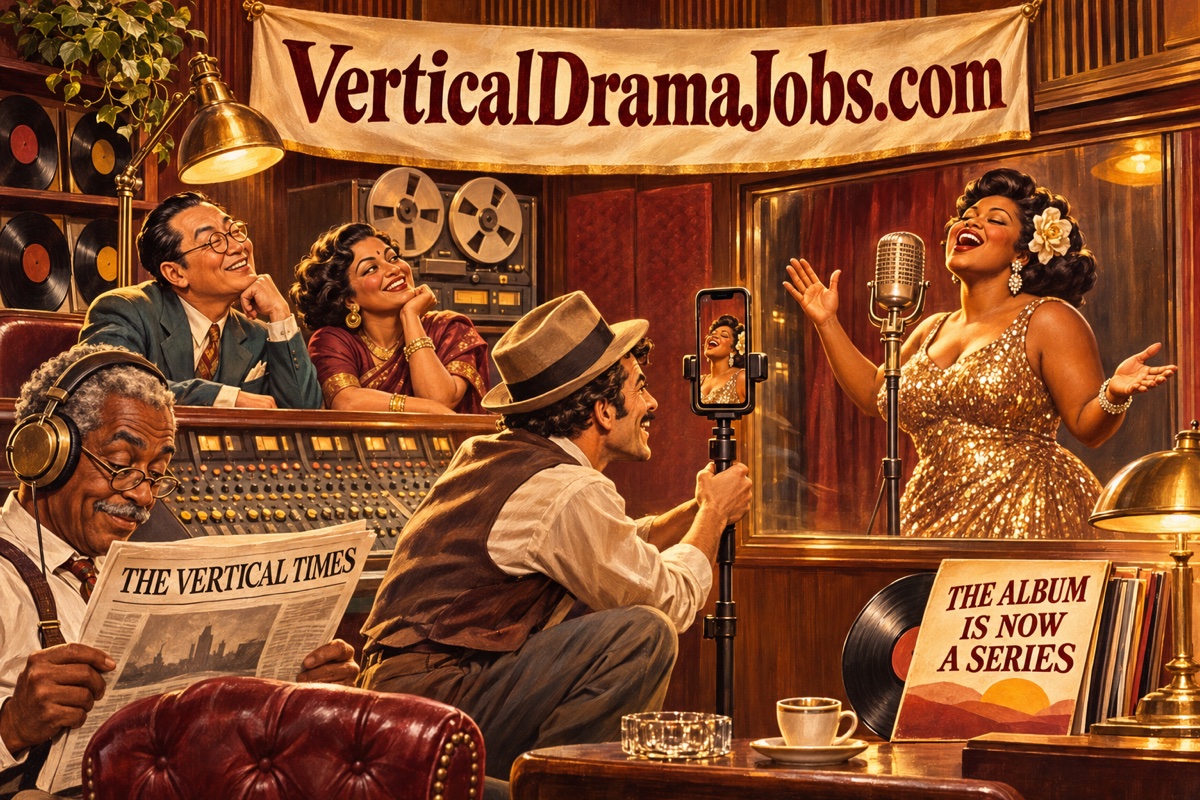
TikTok and Ampersand made To Die For Love, an 81-episode musical microdrama. All 81 episodes come out December 21 on TikTok and PineDrama, and Atlantic Records is putting out the soundtrack. Grammy winners Abigail Barlow and Emily Bear wrote the songs, and Barlow stars with Derek Klena.
It was shot in Los Angeles under SAG-AFTRA and Directors Guild contracts, with a cast and crew of 125 (Net Influencer, Nov 19).
Macy Gray will release her first album in almost a decade inside a ReelShort series. The Trouble With the Truth stars Gray and uses songs from the album of the same name. ReelShort's Sunflower Studio is casting now, filming starts in January and the album is due early in 2027 (Variety, Nov 23).
The vertical streamer Epis ordered two true crime series from Fremantle's Silvio Productions, one of them about the death of banker Edmond Safra. Epis already carries more than 75 true crime titles cut down from longer shows (Deadline, Nov 20).
Documentary distributor Dogwoof is doing something similar with Tattle TV, which will turn two of its films into vertical series with AI-assisted production (Deadline, Nov 23).
|
Vertical Drama Jobs Every vertical drama job, from the studios' own career pages Free accounts open 3 fresh jobs a week. Pro opens every job.
|
Brands bought the whole story

Crocs paid for three seasons of Charmed to Meet You on ReelShort, and Crocs owns the show. It's free to watch, and the last season went live November 21. ReelShort says the first two seasons drew 25.2 million views.
Carly Gomez, who runs marketing for the Crocs brand, says they can't yet tell whether those views turn into sales (Forbes, Nov 24).
DramaBox made 3 Days Till I Do for Toyota, a wedding story and DramaBox's first original about Indian culture, with a cast and crew of Asian heritage. Its US team wrote and shot it over three months, all without AI (Deadline, Nov 20).
Superdrug launched The Joy Express, a six-part Christmas romance set on a Superdrug-themed train, on Instagram and TikTok. They shot it in three days with a crew of more than 50 (365 Retail, Nov 23).
In Germany, the organic grocery chain Denns BioMarkt made Christmas Impossible, 12 one-minute episodes shot upright in one of its Berlin stores. Three new episodes go up on Meta, TikTok and YouTube each Advent Sunday, starting November 29 (Denns press release, Nov 20).
In India, ZEE's BULLET app made First Meets, a six-part dating series, for the matchmaking app Luv.com (MediaNews4U, Nov 23).
Governments are buying shows too. France's government information service made Traces, five three-minute episodes about the damage drug trafficking does, aimed at 18 to 30 year olds. It has played on French TV and social apps since November 23 (Influencia, Nov 24).
Rupert Britton, a UK consultant who works on branded entertainment, tracked every branded micro drama he could find from November 2025 to November 2026, 104 in all, and put what he found in a free white paper.
His biggest surprise was length. Of the 70 series with a known episode count, the typical one has six episodes, while the typical English-language series on the drama apps has 58. Brands are making mini-series, he says, and borrowing the look of micro drama without the hooks that keep people coming back.
Most stay off the apps, too: 78 went out on TikTok, Instagram, YouTube and other open social channels, and only 13 showed up on a drama app. Only 21 used social media creators, and 56 used professional actors or celebrities.
Outside China, 63% lean on comedy. Banks and payment brands made 9, as many as tech companies. Just 3 shared a budget, and 61 never published results for the series itself. And it's speeding up: 70 launched in the second half of his year, against 32 in the first.
In India, Pratilipi charges about $32,000 to $43,000 (Rs 30 to 40 lakh, at Rs 92.9 to the dollar) to work a brand into a 35-episode series, and a fully custom branded show can run about $54,000 to $108,000 (Rs 50 lakh to Rs 1 crore) (afaqs!, Nov 24).
Something new from us. A company asked us to help produce a summit all about brands making shows. Branded series, branded entertainment, branded micro dramas, branded Vertical TV as of this week. Whatever you call it, we'll be there. More soon.
Platforms and money
NetShort, DramaWave, DramaBox and CashFlicks vanished from Vietnam's App Store around November 23, while ReelShort is still there. Nobody has said why (Báo Đà Nẵng, Nov 24).
Storyshort, a French vertical drama app, is raising about $1.1 million (€1 million, at $1.10 to the euro) to grow across French-speaking countries and hire creative and tech staff. It has made 54 original series so far (Net Influencer, Nov 19).
Balaji Telefilms told investors it plans more than 500 microdramas over the next five years (Multibagg, Nov 19).
India's public broadcaster Prasar Bharati made its first microdrama with Meta. Scam se Bacho warns viewers about online scams, and it plays on Instagram first, then on Prasar Bharati's Waves streaming app (exchange4media, Nov 19).
TV channels kept moving onto the phone. Spain's RTVE says its vertical improv show Estúpido Cupido is the biggest original launch in RTVE Play's history, with more than 3.5 million views in its first week (RTVE, Nov 24).
In Japan, Fuji TV's FOD SHORT app turned one of its originals into a 61-episode revenge series (PR Times, Nov 20). Yomiuri TV, TVer and the drama app Tatedora are making Frenemy Game in both upright and wide versions, starting December 1 (ENCOUNT, Nov 22).
Chile's TVN has two new shows on its free TVN Vertical app this week (TVN, Nov 20).
Colombian actors Laura Taylor and Sebastián Gómez launch Latium on November 25 in 64 countries, after putting about $1 million into it. Every episode can be watched upright or turned sideways, and they say they want human crews on their shows, not AI (PRODU, Nov 24).
|
The Vertical Film School Podcast The business and craft of vertical drama, from the people making it Hosted by Chi Odogwu. Watch on YouTube or listen on Spotify and Apple Podcasts.
|
AI and the people it affects
Shortical, an AI microdrama startup, wants people to license their faces for its shows. Its new series Inevitable uses a digital copy of Israeli actor Aki Avni, who plays himself. Shortical won't say what it pays and says royalties are worked out case by case. Nobody has signed through its public sign-up page yet (TechCrunch, Nov 21).
China kept cleaning house. Hongguo, ByteDance's free drama app, says it blocked or pulled 12,323 AI dramas and 91 live-action ones in October, most of them before they went live. It has also handled almost 44,000 complaints about people's faces and likenesses being used without permission (National Business Daily, Nov 22).
WeChat pulled more than 100 dramas the same weekend on orders from regulators (Cailian Press, Nov 22).
In India, Eloelo Group, which owns the drama app StoryTV, opened Dolphin AI Film Studio. It's meant to take a show from script to finished video and keep faces, places and props the same from shot to shot. It starts with microdramas (Entrackr, Nov 23).
Numbers worth saving
- Eight big drama apps grew their US monthly users 93% this year through September, per Sensor Tower. But the money people spent inside the apps fell in each of the first three quarters, and churn, the share of users who stop using an app, averaged almost 60% (Net Influencer, Nov 24).
- Kuaishou says the number of short dramas active on its app each day is up more than 350% since January (Kuaishou results, Nov 19).
- Microdramas will bring in $270 million in Latin America this year, up 82% on last year, per research firm Omdia. Brazil and Mexico make up 62% of it (Advanced Television, Nov 20).
- A minute of microdrama costs ShareChat's QuickTV about $215 to $270 (Rs 20,000 to 25,000) to make with actors, and about $75 to $86 (Rs 7,000 to 8,000) with AI tools (Inc42, Nov 19).
Dates for your calendar
- December 14: finalists hear back in the vertical pitch contest that C21 and Shorta run at Content Americas. Entries have closed, and the live pitch is January 19 in Miami (C21Media).
|
Advertise in The Vertical Times Put your studio, app or event in front of the people who make vertical drama 1,200+ subscribers each week: writers, producers, editors, actors and studio teams.
|
Worth a read
- Women in Vertical Media names its first advisory circle, Deadline, on the producers, writers, casting directors and platform execs behind the new group.
- Advait Chandan makes his microdrama debut, Bollywood Hungama, on the Secret Superstar director's seven-episode branded series.
- At 70, Cheung Kwok-keung makes his microdrama debut, Lianhe Zaobao, on a Hong Kong actor with more than 250 credits shooting a whole series in about 10 days.
- How the micro-series trend upends conventional advertising films, Hindustan Times, on Indian brands swapping one ad film for a run of episodes.
- The 90-Second Shows Addicting America, The Free Press, on a skeptic who got hooked anyway.
See you next week. Know a story or a job we missed? Hit reply.
The Vertical Times is the weekly news and hiring paper for vertical drama from Vertical Drama Jobs.