What Percentage of Micro Dramas Succeed? The Portfolio Math Behind Vertical Drama Budgets
Only a sliver of micro dramas succeed. Nobody in vertical drama publishes a clean breakout percentage, but every comparable hit business shows the same shape: a small slice of titles carries the return, and the rest earn little and disappear.
That changes how the whole industry should be read. Vertical drama looks like a creative business run on taste. Underneath, it's a portfolio business run on selection and volume. The winning skill is spotting, early and cheaply, which title is starting to behave like a hit.
This guide comes from The Vertical Frontier, Volume Two: Where the Money Is Hiding, an aggregate synthesis of first-hand industry discussions, structured interviews in five markets, independent audience research and outside industry data. It covers the opening of Finding 01 and the first of its three moves. If you're new to the series, start with Volume One: 8 truths about the microdrama industry.
Key takeaways
- There is no verified breakout rate for micro drama. The evidence shows a sliver of winners and a long tail of titles that earn little, the same curve seen in mobile games, romance publishing and platform charts.
- A business with that curve is a portfolio business, and its core competence is triage.
- Typical US vertical drama budgets run $100,000 to $250,000, with premium productions at $400,000 to $600,000.
- Budget doesn't predict return. Titles at every point on that range have flopped and broken out.
- The number that matters is the ratio between what a title costs and what its audience will spend to finish it.
What percentage of micro dramas succeed?
A sliver. Anyone who gives you a precise percentage is guessing.
No public dataset gives a verified breakout rate for micro drama specifically, and Volume Two refuses to invent one. Instead it looks at the businesses vertical drama borrowed its funnel from. Mobile games, romance publishing and the charts on the platforms themselves all publish their version of the number, and they all rhyme. A handful of names dominate, and the bulk of the catalog earns very little.
The platform evidence points the same way. Catalogs on the largest platforms run into the tens of thousands of titles a year (Vitrina.ai; Plot Party, 2026). A single breakout title drove NetShort's revenue up 171 percent quarter over quarter in Q1 2025 (Vitrina.ai, 2026). ReelShort's headline title reached 356 million views, while thousands of other titles on the same platforms earned little (Filmustage, 2026). There's no evidence that this industry's curve is gentler than the ones around it.
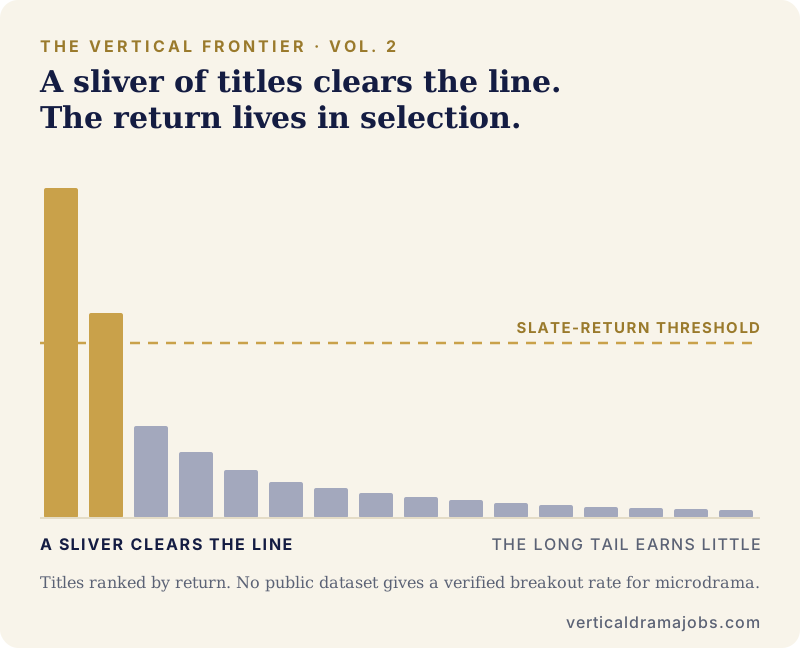 Figure: A sliver of titles clears the line, the same shape every adjacent hit business shows. Cheap production buys more tickets in the portfolio, not a better object. Directional estimate from the aggregate synthesis, not audited data.
Is vertical drama a hits business or a portfolio business?
It looks like a hits business but runs like a portfolio.
In a hits business, talent and taste are supposed to produce the winner. You pick carefully, spend well and make the best possible object. In a portfolio business, you accept that you can't reliably pick the winner in advance. So you place many affordable bets, watch them closely and put money behind the ones that start working. Volume Two puts it in one line: the core competence is not production, it is triage.
Craft still matters. A good hook helps, and a bad one dies. But craft alone doesn't explain who wins, because the same craft goes into titles that break out and titles that vanish. The operators who last have a system for telling them apart early.
| Hits business thinking | Portfolio business thinking | |
|---|---|---|
| Core skill | Making the winner | Spotting the winner early |
| Budget logic | Spend more to raise the odds | Spend enough to get a fair test |
| What cheap production buys | A worse object | More tickets in the portfolio |
| How a flop is read | A failure of taste | An expected result of the curve |
| Where money goes after launch | Spread across the slate | Concentrated behind titles that are working |
| Decisive question | Is this good? | Is this behaving like a winner? |
What triage looks like in practice
Triage is three habits, and Volume Two names each one as a place where operators leave money on the table. The first, covered here, is knowing that production value is decoupled from return. The second is reading acquisition math by cohort instead of by first sale. The third is moving the greenlight decision to the demand side, before production. Those last two have their own guide: micro drama unit economics, CAC, payback and cohorts.
How much does a vertical drama cost to make?
In the US, vertical drama budgets typically run $100,000 to $250,000. Premium S-class productions reach $400,000 to $600,000 (Variety, November 2025, citing Media Partners Asia). Operators describe the same spread: around a hundred thousand dollars up to five or six hundred thousand for a premium slate.
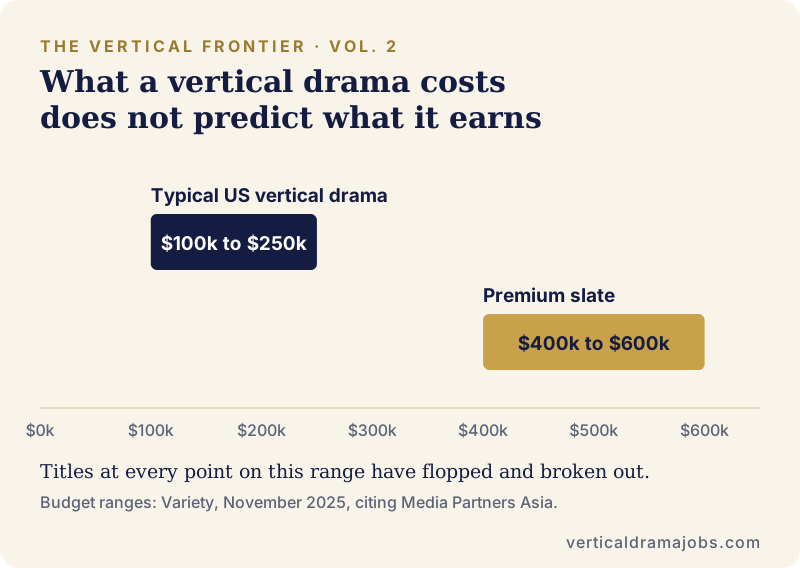 Figure: Typical US vertical drama budgets run $100,000 to $250,000, with premium S-class productions at $400,000 to $600,000.
Those are cash budgets. For why they sit so far below traditional TV, and who covers the rest of the cost, read why vertical drama budgets are so low.
Does budget matter for vertical drama?
Not the way most people expect. Operators tracking hundreds of titles report a non-relationship: what a vertical costs and what it earns don't move together. Titles at every point on the budget range have flopped, and titles at every point have broken out. A show shot for a fraction of another routinely out-earns it many times over. A lavish one can return nothing at all.
Why the audience can't see your budget
The reason is the screen. A viewer is on a phone, deciding at a swipe. They can't see the budget, only feel the hook.
Gloss that would read on a cinema screen or a big TV often disappears in a small vertical frame, so money spent on it is money the viewer never registers. What survives the trip is the premise, the face, the line, the cliffhanger. A bigger budget often looks a little better. What matters is whether that extra spend changes what the audience will pay to keep watching, and usually it doesn't.
The ratio that actually predicts return
Volume Two names the variable that matters: the ratio between what a title costs and what its audience will spend to finish it.
That reframes the budget debate. The winning move is to know the number below which a title isn't worth finishing, and hold that line whatever the title cost. A low-budget title that viewers pay to finish can be a great investment. A premium title they abandon after the first block is a bad one, however good it looks. The budget is only half the ratio, and the audience supplies the other half.
| Budget question | What it misses | Better question |
|---|---|---|
| Should we spend more to raise quality? | Gloss is flattened on a phone | Will this spend change what viewers pay to finish? |
| Should we cut the budget to save money? | Cheap titles flop too | What is the cost ceiling this hook can carry? |
| Is this title too expensive? | Cost alone says nothing about return | Is spend-to-finish above our line? |
| Should we keep backing this title? | Sunk cost isn't a reason | Is it behaving like a winner right now? |
Why does cheap production buy more tickets?
In a hits business, a cheaper production is a worse product. In a portfolio business, it's often a cheaper test. The same money that funds one premium title can fund several lean ones, and each lean title is another ticket in a draw where only a sliver wins.
Cheap isn't automatically smart, since a title still has to be good enough to give its hook a fair chance. But this is why operators who look stingy from the outside often outperform those who spend heavily. They aren't buying a better object. They're buying more chances to find the one that works, then concentrating money behind it.
What this means for your career
Portfolio thinking changes what makes you valuable on any vertical drama team, executive or not.
Producers
Your job is triage as much as production. For each title, learn to state the cost line it has to clear and the early signals that tell you whether it's clearing it. Stop defending budgets by how good the show looks, and defend them by the spend-to-finish ratio you expect. When a title clearly isn't working, be the person who says so first. Browse producer jobs and studio jobs with that skill in your pitch.
Writers
The hook is the one thing the audience can feel on a phone, and the hook is yours. That puts writers at the center of the part of the ratio budget can't buy. Write openings and cliffhangers that make finishing feel urgent, and expect that many good scripts will still land in the long tail. That's the curve at work, so don't take it as a verdict on your talent. Keep your volume up, because volume is how a portfolio finds its winners. See vertical drama writer jobs.
Directors
Spend your effort where the small screen shows it: faces, performance, clarity of the beat. Prioritize what keeps a viewer paying over what impresses a peer. Find director jobs on the board.
Actors and crew
Most of your credits will be on shows that never break out. That's normal in a portfolio business. Build a body of reliable work, because when a title does break out, the people who were dependable on the lean shows get called back. Browse casting calls and production crew jobs.
Frequently asked questions
What percentage of micro dramas succeed?
There's no verified number. The evidence points to a sliver of titles carrying the return, as laid out above.
Does budget matter for vertical drama success?
Less than most people think. Cost and earnings don't move together. What predicts return is the ratio between what a title costs and what viewers will spend to finish it.
How much does a vertical drama cost to make?
See the budget ranges above: $100,000 to $250,000 for a typical US title, and up to $600,000 for premium productions.
What is triage in vertical drama?
Spotting early, cheaply and often which titles are behaving like winners, then backing those and letting the rest go. Volume Two calls it the core competence of the business.
Is it better to make one expensive vertical drama or several cheap ones?
Usually several lean ones, because each is another chance to find a winner. That only holds if each title gives its hook a fair test and you put money behind whichever one starts working.
Sources and notes
- The Vertical Frontier, Volume Two: Where the Money Is Hiding (2026), by Chi Odogwu: Finding 01, an aggregate synthesis of first-hand industry discussions, structured interviews in five markets, independent audience research and outside industry data.
- Breakout rate: no public dataset gives a verified breakout percentage for micro drama, so the shape is framed as consistent with comparable hit-driven categories rather than a measured statistic.
- NetShort revenue up 171 percent quarter over quarter in Q1 2025 from a single breakout title (Vitrina.ai, 2026).
- ReelShort's headline title reached 356 million views while thousands of other titles earned little (Filmustage, 2026).
- Catalogs on the largest platforms run into the tens of thousands of titles annually (Vitrina.ai; Plot Party, 2026).
- US vertical drama budgets of $100,000 to $250,000, premium S-class productions at $400,000 to $600,000 (Variety, November 2025, citing Media Partners Asia).
Figures are illustrative of the relationships described and are directional rather than audited.
More from The Vertical Frontier
- The Vertical Frontier, Volume Two: Where the Money Is Hiding
- Micro drama unit economics: CAC, payback and cohorts
- How to finance a vertical drama: the capital stack
- Micro drama localization, AI dubbing and catalog value
- AI and vertical drama: the barbell and the undifferentiated middle
- Why vertical drama budgets are so low: the hidden labor subsidy
- Vertical drama ad spend and the next growth market