Why Vertical Drama Budgets Are So Low: The Hidden Labor Subsidy Behind Micro Drama
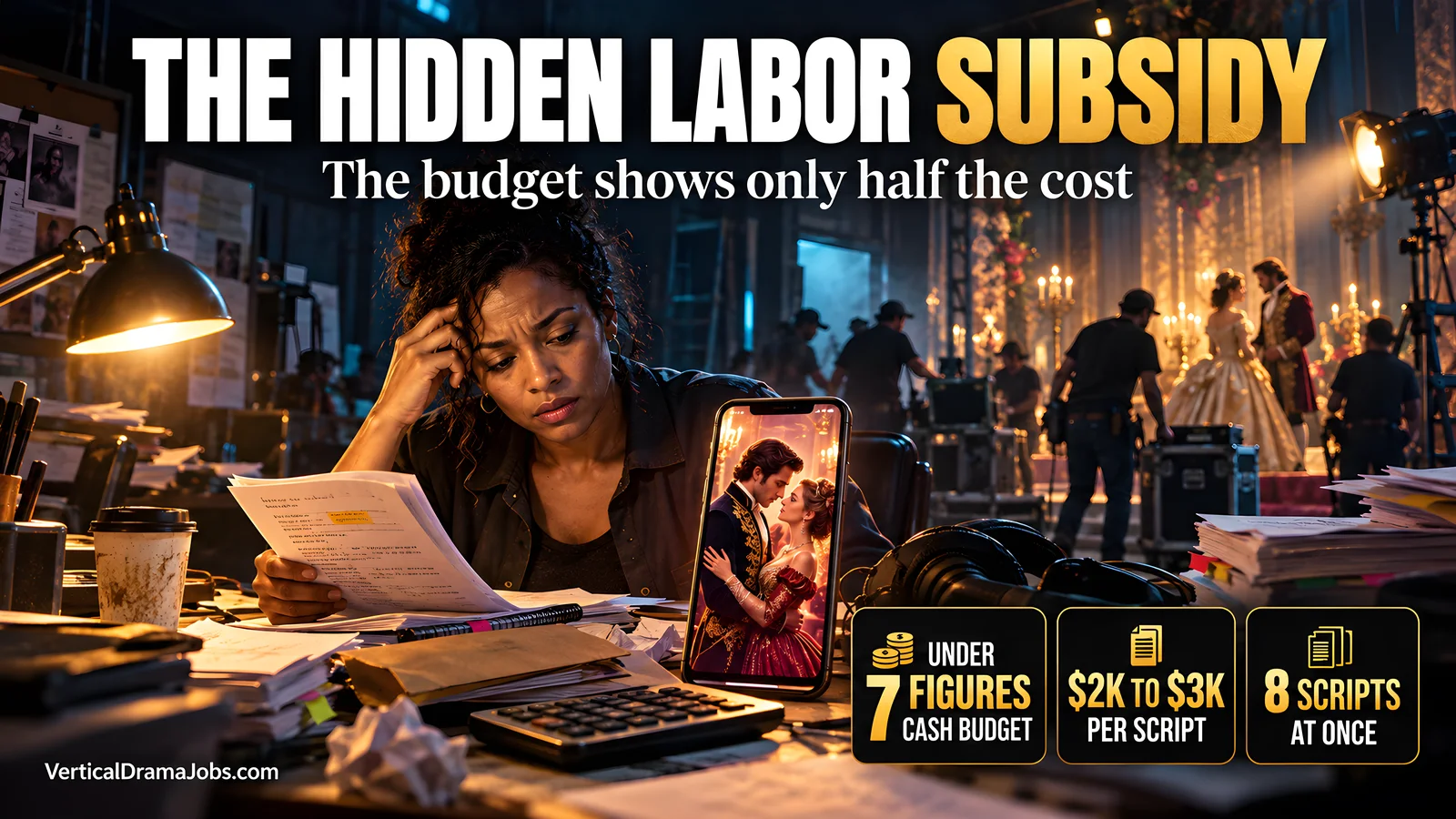
Vertical drama budgets are low because the cash budget only shows part of the cost. The workforce pays the rest, through second jobs, reduced rates, self-funded producers and writers carrying several scripts at once.
A full micro drama series is often made for under seven figures in cash, and rarely far above the middle of six figures. That number is accurate, but it isn't the whole bill. The gap between what a production spends and what it actually consumes is covered by people who earn their living somewhere else.
This guide comes from The Vertical Frontier, Working Paper No. 1, a synthesis of Micro Drama Summit sessions, operator interviews across five markets and independent research. It covers the supply side of Finding 07. The demand side, who watches and when, has its own guide: who watches vertical drama.
Key takeaways
- The cash figure leaves out a large hidden labor subsidy: second jobs, discounted crews, self-funded producers and writers juggling many scripts.
- The cost advantage comes from an immature industry. It isn't built into the format.
- Every win for fair pay (unions, standards, fee advocacy) withdraws part of the subsidy and pushes budgets back toward traditional levels.
- Premium-looking content at today's prices is available only while the industry stays half volunteer.
How much does it cost to make a vertical drama?
There are two numbers.
The first is the cash cost: the money that actually leaves a producer's account to pay cast, crew, locations, gear and post. Next to traditional television budgets, it looks like a production miracle.
The second is what the production actually consumes. That's everything in the cash budget plus the value of the labor people supply below its true cost. Nobody writes that number down. It isn't in a spreadsheet, a pitch deck or a platform's content budget, but it's there on every set.
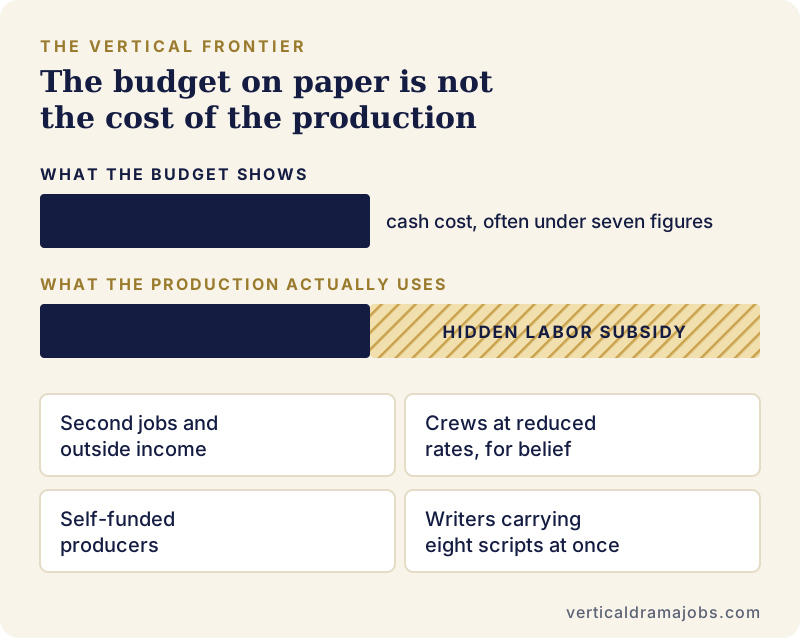 Figure: What the budget shows (cash cost, often under seven figures) versus what the production actually consumes (cash plus a hidden labor subsidy from second jobs and outside income, crews at reduced rates, self-funded producers, and writers carrying eight scripts).
The first number is what a platform pays. The second is what the work is worth.
Why are micro drama budgets so low?
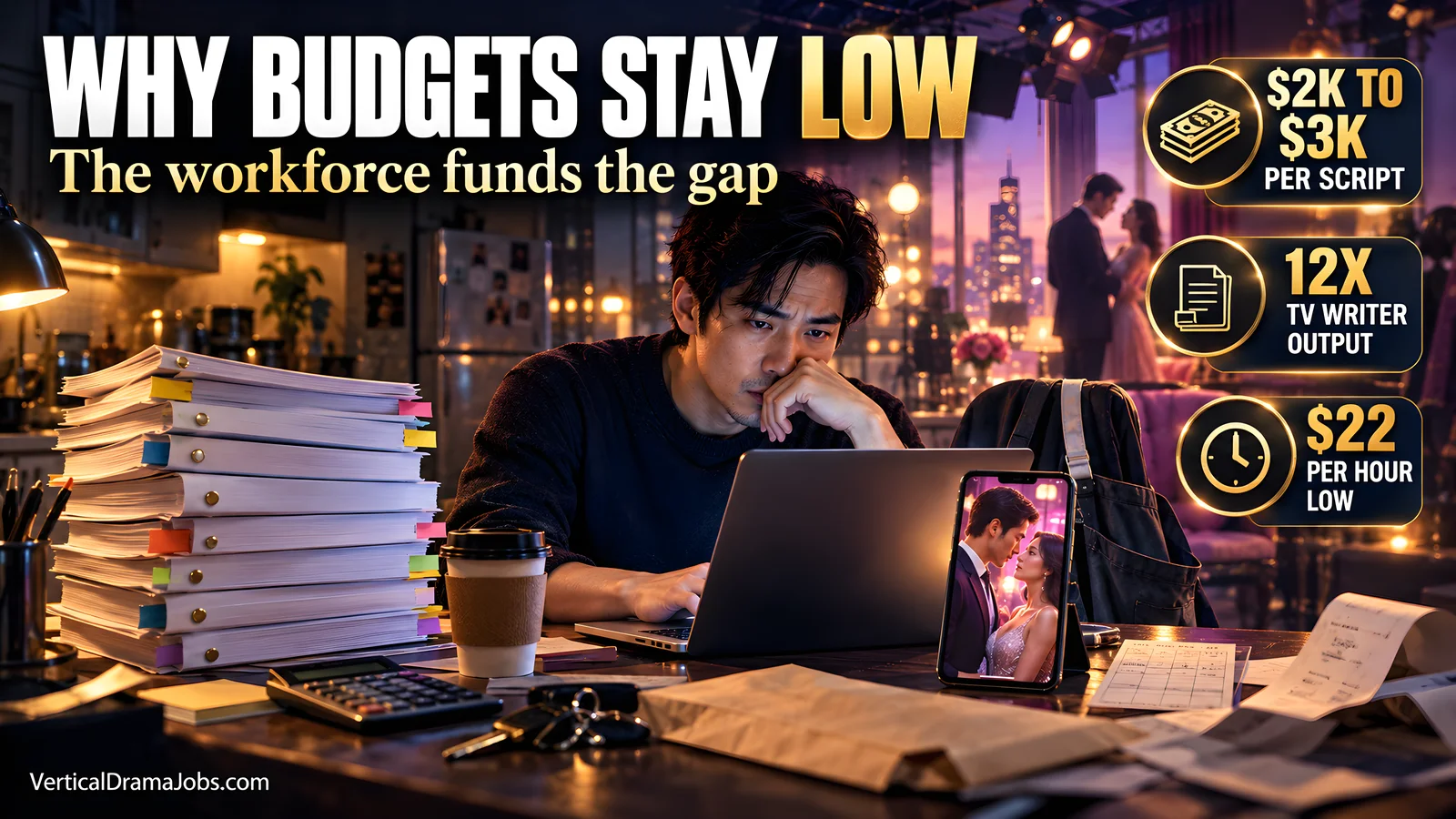 Count the second jobs. Across the sessions and interviews behind the working paper, the pattern repeated in every market. A casting director who also runs a needlework business. Performers who wait tables or manage properties between shoots. A self-funded producer with prior companies behind her, carrying the risk on her own balance sheet. Crews working reduced rates out of belief in the project and the promise of a good wrap party. Writers juggling eight scripts at once because no single script pays a living.
Lean budgets work because the workforce funds them from somewhere else.
The writer's share of the subsidy
Writers are the clearest case. The going rate is about $2,000 a script, with experienced writers pushing to $3,000 and sometimes higher, and it's a flat fee with no back end. At that rate volume is the whole living, which is why a vertical writer may take on a dozen scripts a year, roughly 12 times a traditional TV writer's output.
Trade coverage puts a working vertical writer at around $80,000 a year at roughly a script a month, still below WGA scale (The Ankler, June 2025). Scriptnotes documented flat work-for-hire deals as low as $22 an hour (John August, September 2025). That's the subsidy in plain sight. For the full breakdown, see why vertical drama writers get a flat fee and no residuals.
The crew and performer share
Crew and cast subsidize through reduced rates and outside jobs. Each is a transfer of value from a person to a production, and none of it shows up as a line item.
The producer share
Self-funded producers carry the riskiest piece. When a producer finances a series from her own money or earlier businesses, the capital cost and the risk sit with her, not with the platform that buys or licenses the show.
What a vertical drama budget shows versus what it consumes
The table shows the gap side by side, using only the categories named in the working paper.
| Cost layer | What the budget shows | What the production actually consumes |
|---|---|---|
| Overall cash | Often under seven figures, rarely far above mid six figures | The cash figure, plus labor supplied below its true cost |
| Writers | A flat fee per script, about $2,000 to $3,000 | Writers carrying eight scripts because one does not pay a living |
| Cast | Day rates for the shoot | Performers whose rent is covered by waiting tables or managing properties |
| Crew | Crew rates on the call sheet | Crews at reduced rates, working for belief and a good wrap party |
| Casting | A casting fee | Casting directors who run a second business |
| Producing | Producer fees, if any | Self-funded producers carrying capital and risk |
Every row in the right-hand column is a person paying part of the cost of the show out of their own life.
Is the low cost of micro drama here to stay?
 No. This is the most important part of the finding.
The cost advantage isn't structural. It comes from immaturity, and it eats itself. The more the sector professionalizes, the more the subsidy withdraws. Unions, standard contracts and fair-fee advocacy are all worth fighting for, and each one, when it lands, moves some of the hidden cost back onto the budget where it belongs.
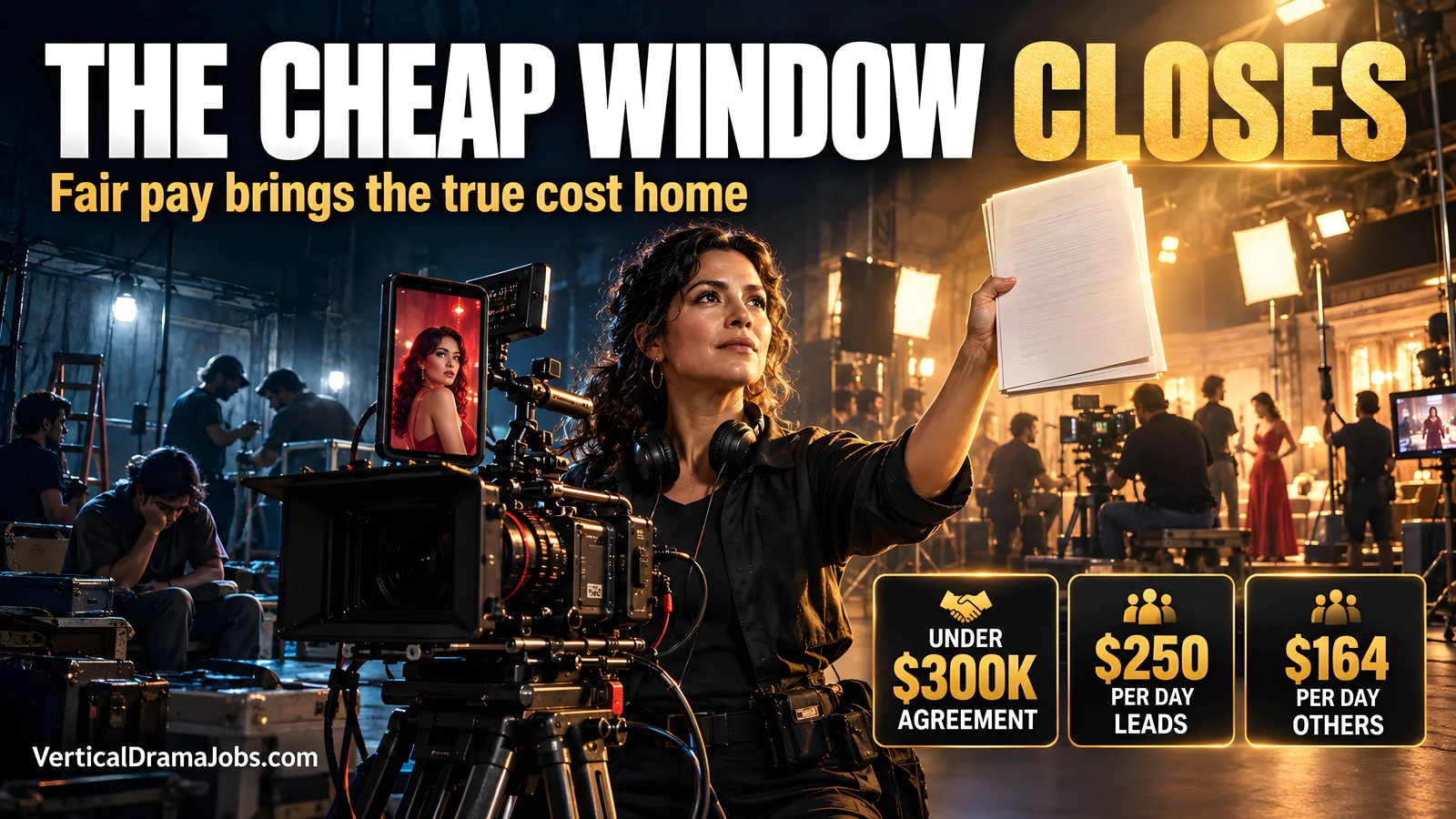
The first moves are already here. SAG-AFTRA's Verticals Agreement, signed October 13, 2025, covers productions under $300,000 and sets minimums of $250 a day for leads and $164 for other performers (Variety and Deadline, October 2025). That's about 20 percent of standard SAG-AFTRA film and TV scale, and analysts noted it can land below what non-union productions already pay experienced leads (Mondaq, 2026). On the writing side, the WGA ruled this work covered by its minimum basic agreement and warned members off non-signatory productions.
These are early floors, set low. But every new floor and standard contract pulls a little more of the true cost into the cash budget.
Why fair pay shortens the cheap-content window
The window for premium content at these prices is the same window in which the industry stays half volunteer, so every deserved win shortens it.
None of this argues against fair pay. It argues for knowing the true price tag. A platform planning its slate on today's budgets is planning on a subsidy that's already being withdrawn.
How professionalization changes vertical drama budgets
| Subsidized phase (now) | Professionalized phase (coming) | |
|---|---|---|
| Who covers the gap | The workforce, through second jobs and reduced rates | The production budget |
| Cash budgets | Lean, often under seven figures | Drifting back toward traditional levels |
| Pay structure | Flat fees, informal deals, belief-based rates | Union floors, standard contracts, fee benchmarks |
| Who can afford to work | People with outside income | A wider pool, because the work pays a living |
| Price of premium content | Unusually low | Closer to its real cost |
The shift won't happen everywhere at once. The working paper's broader finding on timing is that markets follow China, the originating market, at a lag of roughly three years, and some newer markets skip stages. Read the vertical drama global market timeline for that pattern. Expect the subsidy to withdraw on a similar uneven clock.
Who pays when the subsidy runs out?
The buyer: the platform, studio or financier commissioning the series. Budgets go up, or volume goes down, or both.
For people inside the industry, that cuts both ways. The work becomes something you can live on without a second job. But volume that only existed because labor was cheap may not survive.
It also connects to another finding from the paper: openness in this industry is a phase, and the gates close in the order they opened. See how long the no-gatekeepers window stays open. Professionalization is one of the forces closing those gates.
What this means for your career
The subsidy touches everyone who works in vertical, on set or off.
Writers
Know what you're subsidizing. If you're carrying eight scripts because no single one pays a living, track your actual hourly rate across a full series, not just the per-script fee. That number is your best tool in any rate conversation. Check WGA guidance before taking work with non-signatory productions, and keep your credits documented so you can push from the base rate toward the top of the range. Browse vertical drama writer jobs with that number in mind.
Actors
Your day rate is only part of the picture. Count the travel, the self-tapes and the unpaid prep. If you're union, learn the Verticals Agreement floors, and remember a floor is a minimum, not a ceiling. Our 2026 vertical drama actor pay rates guide covers the ranges by role. Find work on casting calls.
Crew
Reduced rates for belief can make sense early, when the credit or relationship is worth more than the gap. Decide on purpose, and set a point after which you stop discounting. As the sector formalizes, crew with a reputation for fast, reliable work on micro drama sets will be first in line when rates rise. See current production crew jobs.
Producers
If you're budgeting a series, write down both numbers, the cash cost and the true cost, and know which line items lean on goodwill. A budget that only works because your crew is discounting is fragile. When rates rise, you'll want to know exactly where the pressure lands. Self-funding also carries risk a platform doesn't share, so price it honestly. Look for producer jobs and studio roles on the board.
Frequently asked questions
How much does it cost to make a vertical drama series?
Often under seven figures in cash, and rarely far above mid six figures. The true cost is higher, because that figure leaves out the hidden labor subsidy.
Why are micro drama budgets so much lower than TV budgets?
Much of the answer is that the workforce funds the shows from outside income. See the budget table above.
Will vertical drama budgets go up?
The working paper expects them to drift back toward traditional levels as the sector professionalizes. Timing will vary by market.
Does the SAG-AFTRA Verticals Agreement raise budgets?
It sets a floor, not a full market rate, so its early effect on budgets may be small. Some non-union productions already pay experienced leads more.
Is working in micro drama a good career if the pay is low?
It can be, especially for building credits and relationships while the industry is still open. Go in clear about what you're subsidizing, and set limits.
Sources and notes
- The Vertical Frontier, Working Paper No. 1 (2026), by Chi Odogwu: Finding 07, aggregate synthesis of Micro Drama Summit sessions, operator interviews across five markets and independent research.
- Writer pay ranges: prevailing rates of $2,000 to $3,000 per script, with experienced writers at the upper end. Working writer income of around $80,000 a year at roughly a script a month, below WGA scale (The Ankler, June 2025).
- Flat work-for-hire deals as low as $22 an hour, no residuals, at-will cancellation (Scriptnotes, John August, September 2025).
- SAG-AFTRA Verticals Agreement, signed October 13, 2025, for productions under $300,000: $250 a day for leads, $164 for other performers, about 20 percent of standard scale (Variety and Deadline, October 2025; Mondaq, 2026).
- WGA ruling that this work falls under its minimum basic agreement (John August; Variety).
Figures are illustrative of the relationships described and are directional rather than audited.
More from The Vertical Frontier
- The Vertical Frontier: 8 truths about the microdrama industry
- Who watches vertical drama: audience demographics for 2026
- Vertical drama writers: flat fee, no residuals, explained
- No gatekeepers: how long the vertical drama window stays open
- Vertical drama's global market timeline: China, US, MENA and LatAm