How Much Do Vertical Drama Writers Get Paid Per Script? The Flat Fee, No Residuals, Explained

A vertical drama writer is typically paid a flat fee of about $2,000 per script, with experienced writers pushing to $3,000 and sometimes higher. There are no residuals, no ownership and no share of what the series earns, even when a title clears hundreds of millions of views.
That deal is extractive, and the push to reform it is overdue. It's also the reason the micro drama business moves as fast as it does. If you write for this format, you need to understand both halves.
This guide comes from The Vertical Frontier, Working Paper No. 1, a synthesis of Micro Drama Summit sessions, operator interviews across five markets and independent research. It covers Finding 05, which the paper calls "the shallow deal is the velocity engine," plus what has happened as unions moved in to formalize pay.
Key takeaways
- The going rate is about $2,000 a script, with track-record writers at $3,000 or higher. One check, no claim on what the show earns.
- Micro drama writers get no residuals in any market the paper looked at.
- The missing back end is what makes the industry fast. One-page paperwork lets a platform commission a series in a week and lets a writer take on a dozen a year.
- SAG-AFTRA's Verticals Agreement set floors of $250 a day for leads and $164 for other performers. The WGA ruled this work falls under its basic agreement.
- Participation and velocity trade against each other, and nobody has priced that trade yet.
How much do vertical drama writers get paid per script?
The headline number is $2,000 to $3,000 per script, which is the prevailing rate for a full series screenplay. Writers with a track record push to $3,000, and some go higher.
The market prices the same work a few other ways:
- Per finished minute. Freelance listings quote about $40 to $100 per finished minute (Upwork, 2026).
- Per hour, in practice. The Scriptnotes podcast documented flat work-for-hire deals that worked out as low as $22 an hour, with no residuals and at-will cancellation (John August, September 2025).
- Per year. Trade coverage reported that a working vertical writer may clear around $80,000 a year at roughly a script a month. That's still below WGA scale, though a handful of writers reach six figures (The Ankler, June 2025).
The fee doesn't move. A hit can't reprice the writer's deal after the fact, because there's nothing in it to reprice.
For the craft side, read how to write a vertical drama script. For how people land a first paid script, see vertical drama writer jobs: how to break in and what they pay.
Do micro drama writers get residuals?
 No. In every market the paper covers, the writer's deal is the same: flat fee, no ownership, no participation. You're paid once for the script, and if the show becomes a hit, the platform keeps the upside.
Writers coming from film and TV find this the hardest part to accept. In traditional television, residuals and participation are how a writing career compounds. In vertical drama they're absent by design, not by oversight.
What "no back end" actually removes
Strip residuals out of a deal and a whole layer of machinery goes with them: residual accounting, participation counsel, fights over how profit is defined, chain-of-title thickets. None of that exists in a typical micro drama writing deal. The paperwork is one page.
Why does the flat fee make vertical drama so fast?
 This is the least obvious part of Finding 05: the shallow deal drives the whole production model, and cost is only one piece of it.
With one page of paperwork, a platform can commission a series in a week. With no back end to negotiate, a writer can take on a dozen scripts a year. At $2,000 to $3,000 a script, volume isn't a bonus for the writer. It's the whole living. The speed of the industry and the thinness of the writer's deal are one fact seen from two sides.
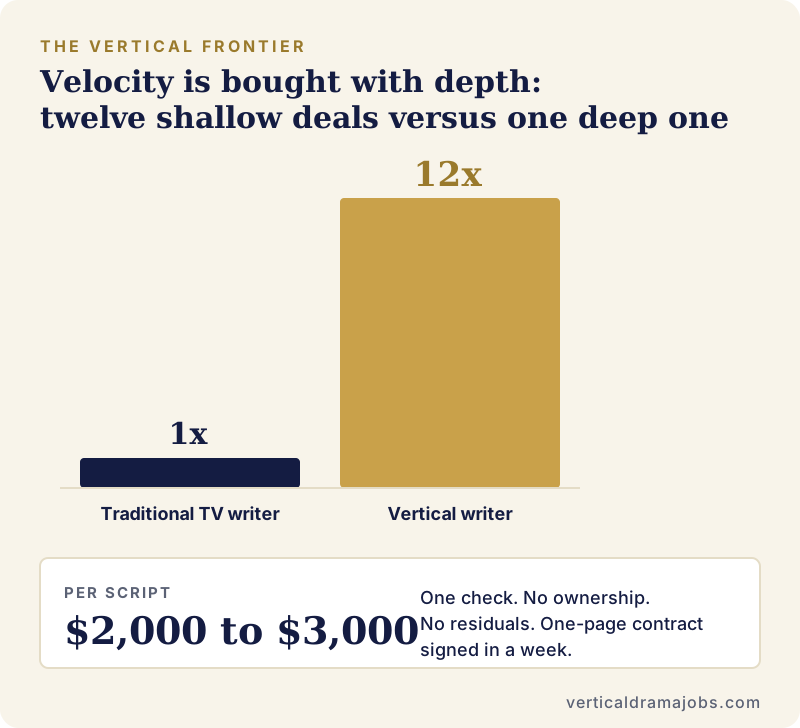 Figure: Annual output per writer, traditional TV writer (1x) versus vertical drama writer (12x), at a flat $2,000 to $3,000 per script.
The 12x throughput number
The paper puts a vertical writer's annual output at roughly 12 times a traditional TV writer's. The script-a-month pace in the trade coverage lines up with that. The paper also notes writers juggling as many as eight scripts at once because no single one pays a living.
That workload is part of what the paper elsewhere calls a hidden labor subsidy: the industry's low cost depends partly on people carrying more work than any single fee justifies. It gets its own guide, why vertical drama budgets are so low.
Vertical drama writer pay compared with traditional TV
The table sets the two deal shapes side by side, using only what the sources report.
| Vertical drama writer | Traditional TV writer | |
|---|---|---|
| Typical pay structure | Flat fee per script | Fee plus a back end |
| Per-script fee | About $2,000 to $3,000 | Not covered by this paper |
| Residuals | None | Part of the back end |
| Ownership or participation | None | Depends on the deal |
| Paperwork | About one page | Residual accounting, participation counsel, profit definitions |
| Annual output | About 12x | 1x baseline |
| Annual income reported | Around $80,000 at a script a month, below WGA scale | Not covered by this paper |
Vertical drama pays less per script and nothing later, but it pays faster and more often.
What is the SAG-AFTRA Verticals Agreement and what does it pay?
Writers aren't the only ones whose pay is being formalized. On October 13, 2025, SAG-AFTRA signed its Verticals Agreement, covering productions under $300,000. The minimums are $250 a day for leads and $164 a day for other performers, about 20 percent of standard SAG-AFTRA film and TV scale (Variety and Deadline, October 2025; Mondaq, 2026).
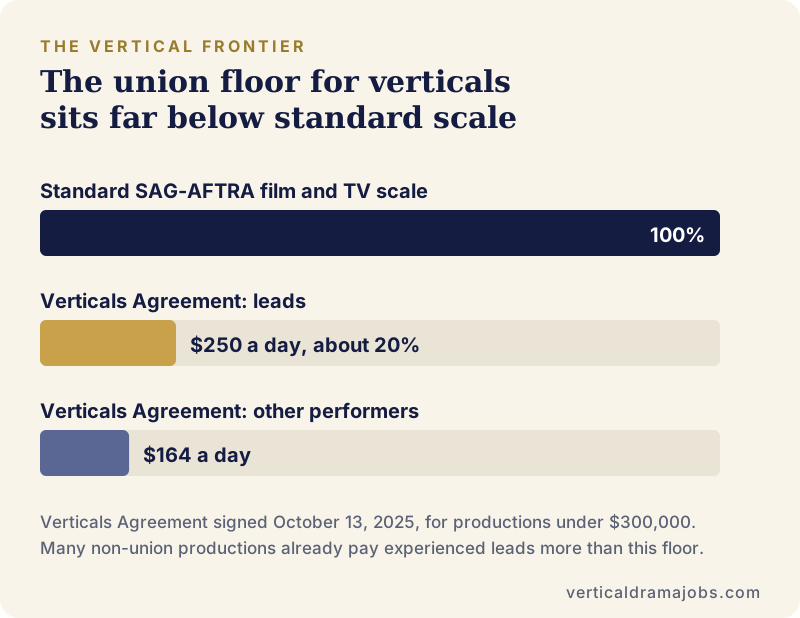 Figure: SAG-AFTRA Verticals Agreement day minimums ($250 lead, $164 other performers) compared with standard SAG-AFTRA film and TV scale. The vertical floor sits at roughly 20 percent of standard scale.
Why the union floor can sit below the going rate
Analysts noted that the floor can land below what non-union productions already pay experienced leads. That happens when the market moves before the rules do. For actors, the union minimum is a floor, not a target. For what performers actually earn, see how much vertical drama actors make.
What are the WGA rules for vertical drama?
The Writers Guild ruled that vertical drama work falls under its minimum basic agreement and warned members off non-signatory productions (John August; Variety).
A wave of writers kept writing under other names rather than give up the volume. Guild coverage brings protection and participation. The flat-fee machine brings speed and steady work. Writers had to pick, and some picked volume.
The paper's verdict is that participation and velocity trade against each other, and nobody has priced that trade. Raise the writer's share and you add paperwork, negotiation and accounting, which slows the one-week commission. Where the balance point sits is still unknown.
It's also part of a wider pattern covered in the no gatekeepers guide. Writing is the layer of the industry that is formalizing right now.
Will vertical drama writer pay go up?
The paper doesn't forecast a number, and neither will we. It does say the reform push is overdue and the pressure is real: a union agreement for performers, a guild ruling for writers, and fair-fee advocacy from some of the industry's best people.
It also says something less comfortable. The low cost of making micro dramas is partly borrowed from the workforce. As the sector professionalizes, that subsidy withdraws and budgets drift back toward traditional levels, so higher pay and a slower, more expensive machine likely arrive together. For the bigger money picture, read we need to talk about the money in micro drama.
What this means for your career
Writers
- Price your time, not just the script. A $2,000 fee looks different at two weeks of work than at two months. Know your own hourly number before you sign.
- Build for volume on purpose. The model pays writers who can deliver a script a month. Templates, a repeatable outline process and fast revisions are part of the job.
- Use the track record as leverage. The jump to $3,000 and higher goes to writers with credits. Keep a clean list of produced titles and any view counts you're allowed to share.
- Read the cancellation terms. Ask how partial work gets paid if a project stops.
- Decide your guild position in advance. If you're a WGA member, the guild has ruled on this work. Make that call with full information, not in the middle of a deadline.
Actors
- Treat $250 as a floor. It can sit below what non-union productions already pay experienced leads.
- Ask which agreement covers the production. The Verticals Agreement applies only to productions under $300,000.
Producers and platform staff
- Know that speed is built on the shallow deal. Any change to writer participation changes how fast you can commission, so plan for it.
- Check signatory status. With WGA members warned off non-signatory productions, it affects who you can hire under their own names.
Frequently asked questions
How much does a vertical drama writer make per script?
About $2,000, with experienced writers at $3,000 and sometimes higher. See the pay breakdown above for per-minute, per-hour and per-year figures.
Do micro drama writers get residuals or royalties?
No. The standard deal is a flat fee with no ownership and no participation, even on a huge hit.
How much can a vertical drama writer make in a year?
Around $80,000 at a script a month, which is below WGA scale. A handful reach six figures.
Can WGA members write vertical dramas?
The WGA says this work is covered by its minimum basic agreement and warns members off non-signatory productions. If you're a member, check a production's signatory status first.
What are the SAG-AFTRA Verticals Agreement rates?
$250 a day for leads and $164 a day for other performers, on productions under $300,000. That's about 20 percent of standard scale.
Why don't vertical drama platforms offer back-end deals?
The missing back end is what makes the model fast. With no residual accounting or profit definitions to negotiate, a series can be commissioned in a week.
Is writing vertical dramas worth it?
It depends on your speed and goals. The pay is modest per script but the work comes often, and it's a strong way to get produced credits quickly if you go in clear about the deal.
Sources and notes
- The Vertical Frontier, Working Paper No. 1 (2026), Chi Odogwu. Finding 05, aggregate synthesis of Micro Drama Summit sessions, operator interviews and independent research.
- Upwork freelance listings, 2026: about $40 to $100 per finished minute.
- Scriptnotes, John August, September 2025: flat work-for-hire deals as low as $22 an hour, no residuals, at-will cancellation.
- The Ankler, June 2025: around $80,000 a year at roughly a script a month, below WGA scale; a handful reach six figures.
- Variety and Deadline, October 2025; Mondaq, 2026: SAG-AFTRA Verticals Agreement, signed October 13, 2025, productions under $300,000, $250 lead and $164 other performer minimums, about 20 percent of standard scale.
- John August; Variety: WGA ruling that vertical work is covered by its minimum basic agreement, and the warning on non-signatory productions.
Figures are illustrative of the relationships described and are directional rather than audited.