Why Vertical Drama Cliffhangers Hit at Episode 10: How the Paywall Wrote Micro Drama's Story Structure

Vertical drama cliffhangers hit hardest at episode ten because that's where the paywall sits. Writers build micro dramas in ten-episode blocks with a detonation at episode ten, and everything before it serves that moment. The business boundary and the story boundary are the same line.
That makes vertical drama possibly the first narrative form whose grammar came from a payment mechanism instead of from artists. It also means the grammar will change when the payment model does, and that shift is already underway.
This guide comes from The Vertical Frontier, Working Paper No. 1, a synthesis of Micro Drama Summit sessions, operator interviews across five markets and independent research. It's Finding 02 in the paper, "the grammar."
Key takeaways
- Writers in every market teach the same shape: ten-episode blocks, with a detonation at episode ten.
- The reason is commercial. The paywall sits at episode ten, so story structure and business structure line up.
- Other forms got their structure from artists first. Vertical drama got its structure from a monetization model imported from serialized web fiction.
- The industry is migrating from paywalled episodes toward ad support, and ad-supported episodes need retention spread evenly, not one big hit at episode ten.
- The cliffhanger instincts being drilled into writers this year have an expiry date. Learn both shapes.
Why does vertical drama paywall at episode 10?
 The paywall at episode ten is a business decision, and the story was built around it. A viewer watches the opening episodes for free. At episode ten, they have to pay to keep going. So the whole opening block exists to make that moment impossible to walk away from.
Ask a writer why ten and they'll point to the paywall.
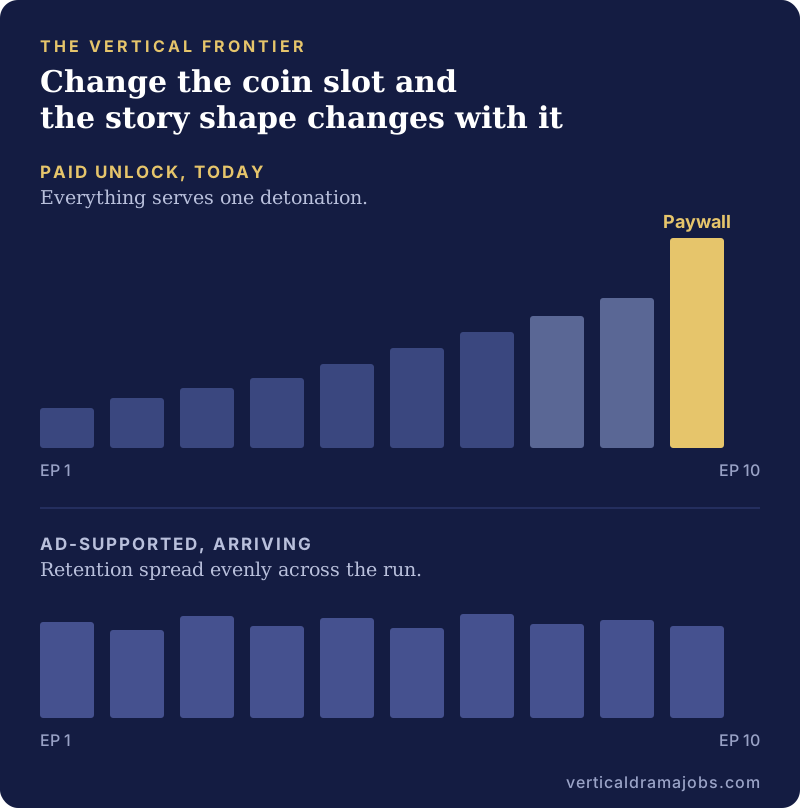 Figure: In the paid model, tension climbs from episode one and peaks at the episode ten paywall. In the arriving ad-supported model, retention is spread evenly across the run. Directional estimate from the aggregate synthesis, not audited data.
Where did micro drama episode structure come from?
Most story forms got their structure from artists, and business adapted later. Vertical drama ran it backward.
Three structures, three origins
| Form | Where the structure came from | Which came first |
|---|---|---|
| Three-act structure | Theater | The art form |
| The TV act break | Took shape from ad slots | The form existed before the ads |
| Vertical drama's ten-episode block | The paywall, imported whole from serialized web fiction | The monetization model |
Three-act structure came from theater. The TV act break took shape from ad slots, but television drama existed before the ads did. In vertical, the monetization model landed first, and the craft grew up around it.
That's why so much vertical drama craft is about the coin slot: the cliffhanger taxonomies, the cycle structures, the rule that you never close a loop without opening another. The paper puts it bluntly: "All of it is scar tissue around a coin slot."
None of that is an insult to the craft. Once you see where it came from, you can see what happens when that changes.
How do ad-supported models change vertical drama story structure?
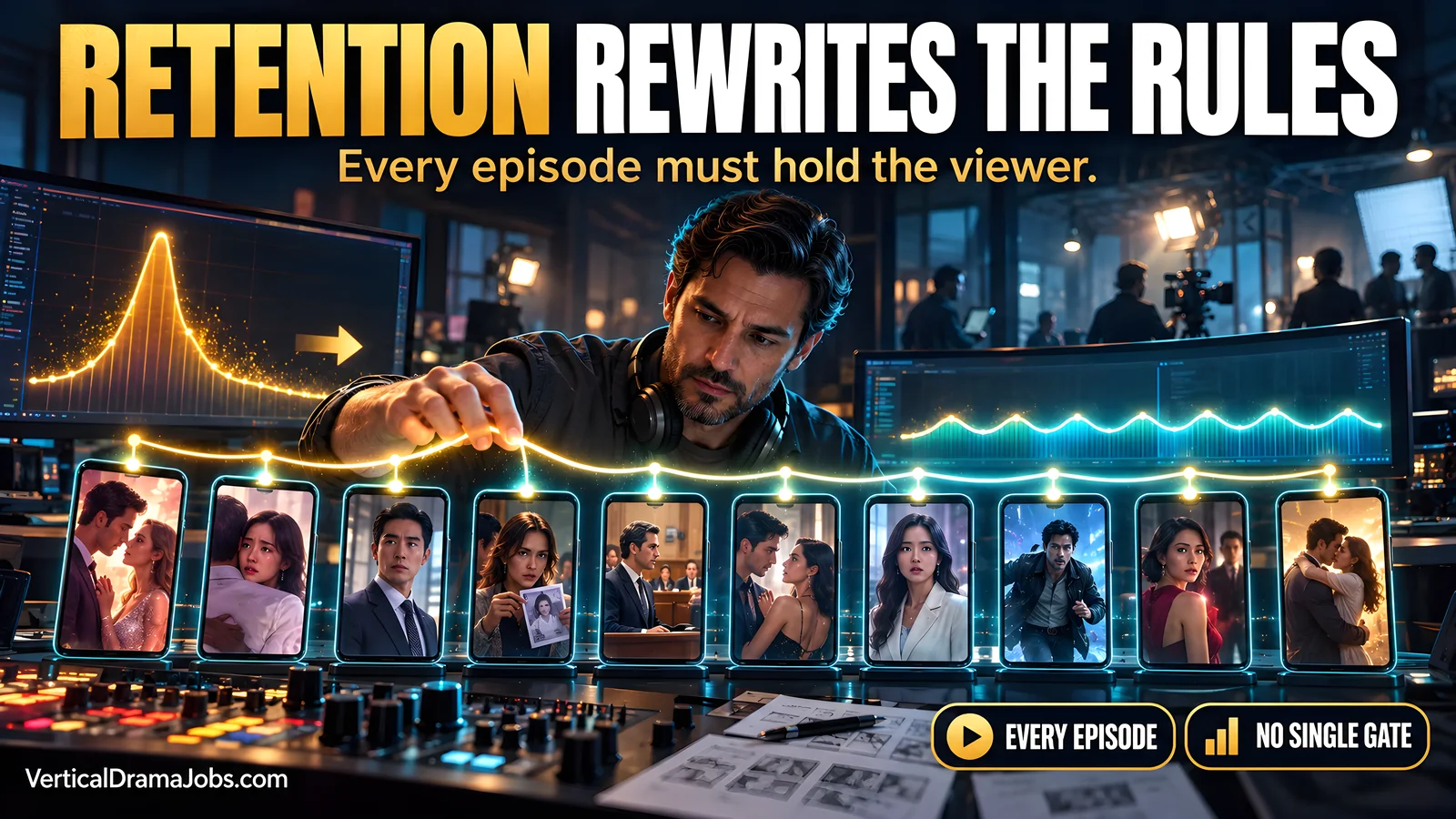 Shift the monetization model and the grammar shifts with it. A paywalled series needs one moment strong enough to make a viewer pay. An ad-supported series earns money every time a viewer keeps watching, so it needs them watching across the whole run. No episode-ten detonation required. Retention spread evenly is what counts.
Paid vs ad-supported, side by side
| Paid model (today) | Ad-supported model (arriving) | |
|---|---|---|
| Where the money moment is | Episode ten, the paywall | Spread across the whole run |
| What the structure needs | A detonation at episode ten | Even retention, episode after episode |
| Tension shape | Rising bars to a peak at ten | Roughly flat across the run |
| Risk for writers | A weak episode ten loses the sale | A sag anywhere loses viewers |
Most of the people teaching the episode-ten instincts haven't noticed they're on a clock.
This isn't happening everywhere at once. The paper's first finding shows that markets move through the same stages at different times, with China roughly three years ahead and the US following, and the move from paywalls toward ad support is one of those stages. Read vertical drama market growth by country for the full timeline.
How to write cliffhangers for vertical drama right now
The paywall model is still dominant, so the episode-ten shape still matters. Here's how to work with it.
Build the first block backward from episode ten
Start with the detonation. Decide what happens at episode ten, then work out what the viewer needs to know, fear and want by that point for the moment to land. Every episode before ten should feed it. If an early scene doesn't set up the detonation, ask what it's doing there.
Never close a loop without opening another
The whole craft runs on this rule. When you answer a question, raise a new one in the same beat. A viewer with nothing left to wonder about has a reason to stop.
Use cycles, not just one big peak
Ten-episode blocks repeat. After the episode-ten detonation, the next block starts building toward its own payoff. Think in cycles, so the series keeps generating reasons to continue.
Say it out loud
The paper's eighth finding describes the craft rule of total on-the-nose clarity: every want and threat spoken aloud, no subtext, because the swipe punishes ambiguity. Cliffhangers follow the same rule. If the threat isn't clear, the hook doesn't land. More on why in how people actually watch micro dramas.
For the full fundamentals of formatting and pacing a script, read how to write a vertical drama script: the complete guide.
How to write for ad-supported vertical drama
If retention has to be spread evenly, every episode has to justify itself. A few ways to think about it:
- Treat every episode as an entry point and an exit risk. There's no single gate to get viewers past. Each episode is a place someone might leave.
- Spread the payoffs. Distribute strong moments across the run instead of saving the biggest turn for episode ten.
- Keep the loop rule. Opening a new question before closing the last one works in both models. It's the most portable skill you have.
- Watch for the flat middle. A structure built to peak at ten can sag after it. In an ad-supported series, a sag is lost money.
You don't have to throw out what you know. Just find out which model you're writing for before you start.
What this means for your career
Writers
Learn both shapes. The most useful writers over the next stretch will be able to write a paywalled series that detonates at ten and an ad-supported series that holds evenly, and tell a producer which one a project needs.
Ask early. When you take a vertical drama writing job, ask how the series will be monetized. It changes the structure, so it should change your outline.
Writers in this business work fast and at volume. The paper's fifth finding covers how the flat-fee deal drives that speed: read vertical drama writer pay: flat fees and no residuals, explained. For the practical side of getting work, see vertical drama writer jobs: how to break in and what they pay.
Directors and editors
The episode-ten moment lives or dies in the cut. If you direct or edit vertical drama, know where the paywall sits and protect the build toward it. On ad-supported projects, the job shifts toward pacing every episode so nothing sags.
Producers and platform staff
When your company moves from paywalls toward ad support, the scripts need to change too. Writers trained on the episode-ten shape may need a new brief, so say so in development. Otherwise someone delivers a paywall structure to an ad-supported slot.
Frequently asked questions
Why do vertical dramas have a cliffhanger at episode 10?
The paywall sits there in the paid model. See the first section above.
What is the typical micro drama episode structure?
Ten-episode blocks, each building to a detonation. The blocks repeat in cycles.
Where did vertical drama story structure come from?
From the business model, not from artists. It came over from serialized web fiction along with the monetization.
Will the episode 10 cliffhanger go away?
It may matter less as ad support spreads. The ad-supported shape is covered in the side-by-side table above.
How do you write cliffhangers for ad-supported micro dramas?
Spread the strong moments across the run instead of saving them for one gate. Every episode is a place a viewer could leave.
Should new vertical drama writers learn the paywall structure?
Yes. It's still the dominant model, and producers expect it. Just don't treat it as permanent, and learn the ad-supported shape too.
Sources and notes
- The Vertical Frontier, Working Paper No. 1 (2026), Chi Odogwu, published by Vertical Film School and Vertical Drama Jobs. Finding 02, "The payment system wrote the grammar," with reference to Findings 01 and 08.
- Aggregate synthesis of Micro Drama Summit sessions (first edition), structured operator interviews across five markets and independent research papers read against one another. Findings are in aggregate and not attributable to any single contributor.
- The episode arc chart is a directional illustration of the two models, not measured retention data.
Figures are illustrative of the relationships described and are directional rather than audited.