Vertical Drama Market Growth by Country: Why China Runs About Three Years Ahead and Latin America and the Middle East Are Skipping Stages

Vertical drama markets grow in a sequence. China, where the format was born, runs roughly three years ahead of the United States, and every stage the newer markets are entering now, China already went through. The newest markets, the Middle East and North Africa (MENA) and Latin America, are skipping stages.
That pattern is the most useful forecasting tool in micro drama. A lot of what looks like uncertainty about where the business is heading is a timeline that's already been published elsewhere, in another language.
This guide comes from The Vertical Frontier, Working Paper No. 1, a synthesis of Micro Drama Summit sessions, operator interviews across five markets and independent research. It's Finding 01 in the paper, which calls it "the clock."
Key takeaways
- The format started in China and spread to other markets at a lag of roughly three years.
- Every phase newer markets are entering, China already left: the explosion of apps, consolidation, the shift from paywalls toward ad support, the arrival of AI content and the widening of genre.
- The Middle East never had a pure paywall era. It launched straight into a four-stream hybrid of subscription, brand integration, redistribution and social.
- Latin America moved from localization to original IP in about eighteen months. The US took closer to three years.
- Markets that develop after the lessons are public may need one year to mature, not three. Forecast them on the old Western curve and you'll be two years late.
How did the vertical drama market grow in China vs the US?
 The micro drama format was born in China. The paper's directional timeline puts China's format birth at roughly 2019 to 2021, the model proven at roughly 2021 to 2022, and consolidation plus AI content at roughly 2022 to 2024.
The United States ran the same sequence about three years later. Format birth landed around 2022 to 2024, the model was proven around 2024 to 2025, and consolidation and AI arrive around 2025 to 2027. Same stages in the same order, about three years later.
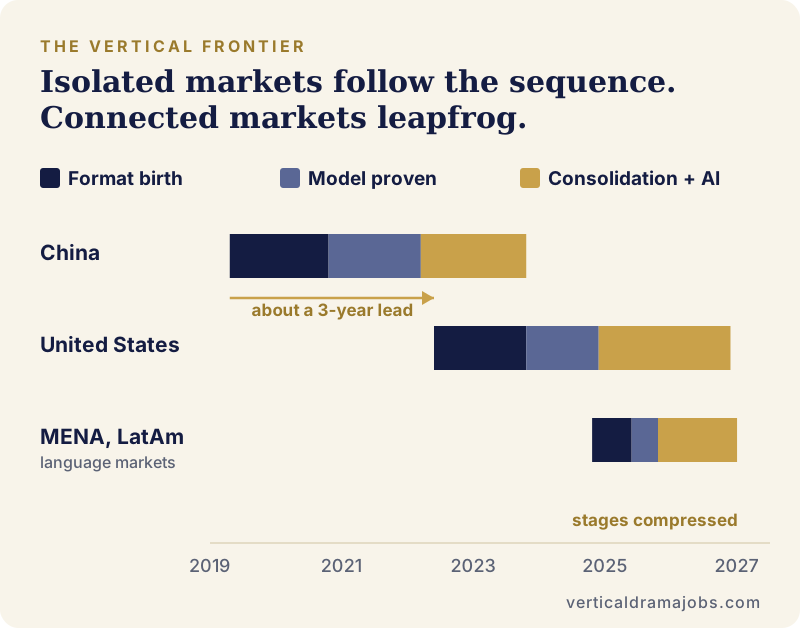 Figure: Format birth, model proven and consolidation plus AI, by market. China leads by roughly three years; MENA and Latin America compress the stages. Directional estimate from the aggregate synthesis, not audited data.
The stages every market has gone through
Newer markets keep repeating this sequence:
- The explosion of apps. A rush of new platforms, all chasing the same audience.
- Consolidation. The field narrows.
- The shift from paywalls toward ad support. Pay-per-episode models start giving ground to ad-supported viewing.
- The arrival of synthetic (AI) content. AI-generated work enters the catalog.
- The widening of genre. The format moves past the stories it started with.
China has been through all five. So when you see a US headline about one of these shifts, ask what happened next in China about three years ago.
Why is China about three years ahead in micro drama?
Because it started first. A format born in one market has to be proven, scaled and fought over there before anyone else copies it. By the time other markets pick it up, the originating one is already into the next phase.
That gives everyone else a preview. Much of what feels uncertain in the US right now, like where ad support is heading, what AI does to the catalog and which genres hold up, has been answered once already. The answers are just in a different language and a different market.
Is micro drama growing in Latin America and the Middle East?
 Yes, and faster than the US did. The paper's timeline puts format birth in MENA and Latin America at roughly late 2024 to mid 2025, the model proven by about late 2025, and consolidation plus AI running from about late 2025 into 2027. The paper labels that stretch "compressed: stages skipped."
The Middle East skipped the paywall era
The US and China went through a paywall phase first and moved toward ad support and other models later. MENA started much closer to the endpoint. It launched straight into a four-stream hybrid:
- Subscription
- Brand integration
- Redistribution
- Social
Latin America compressed localization to original IP
Most markets start by localizing shows from elsewhere, then move to original IP. In the US that move took closer to three years. Latin America did it in about eighteen months.
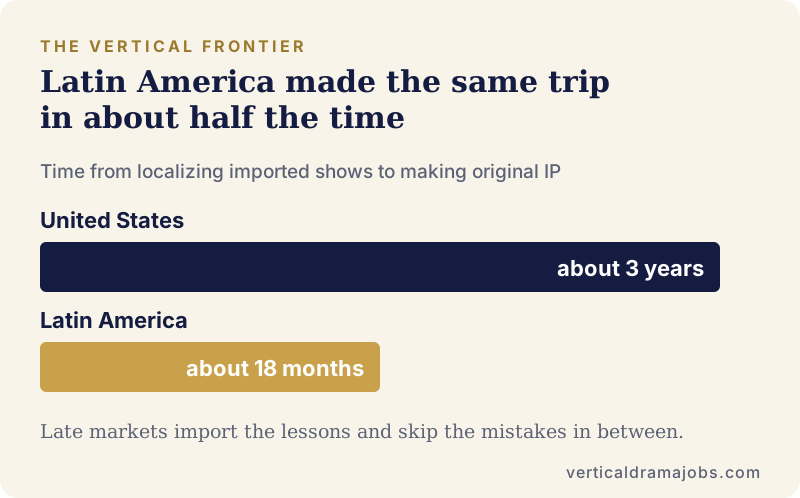 Figure: Time from localization to original IP. Latin America took about eighteen months; the United States took closer to three years. Directional estimate from the aggregate synthesis, not audited data.
Why are newer markets skipping stages?
Both regions imported the format's endpoint lessons without living through the mistakes in between. It's the classic late-adopter leapfrog, like economies that skipped landlines and went straight to mobile. They didn't need to build the old system to see why the new one was better.
Vertical drama works the same way. A market launching after the paywall lessons are public doesn't need its own paywall experiment. A market launching after localization is proven doesn't need three years of it before going original.
How the markets compare
| China | United States | MENA / Latin America | |
|---|---|---|---|
| Role in the sequence | Originating market | Followed at roughly a three-year lag | Arrived latest, compressed the stages |
| Format birth (directional) | ~2019 to 2021 | ~2022 to 2024 | ~late 2024 to mid 2025 |
| Model proven (directional) | ~2021 to 2022 | ~2024 to 2025 | ~2025 |
| Consolidation plus AI (directional) | ~2022 to 2024 | ~2025 to 2027 | ~late 2025 to 2027 |
| Paywall era | Yes | Yes | MENA: none, launched as a four-stream hybrid |
| Localization to original IP | Not covered in the paper | Closer to three years | Latin America: about eighteen months |
How to forecast the next vertical drama market
If the newest markets are skipping stages, the three-year lag stops being a reliable rule for the ones that come next. Markets that develop after the lessons are public may need one year to mature. The paper's model for the next breakout region is simple: everything this industry now knows, applied at once to an audience already fluent in serialized melodrama.
A simple way to read any market
When you're looking at a market you don't know well, ask three questions:
- Where is it in the sequence? Apps exploding, consolidating, shifting to ads, adding AI, widening genre.
- When did it start? Late starters move faster because the lessons are already public.
- Which stages is it skipping? A market that launches with a hybrid revenue model, or goes to original IP early, is on the compressed clock, not the three-year one.
To see where money is moving before a market turns, read the companion guide on why heavy ad test spend marks the next micro drama market.
What this means for your career
The clock tells you when to move, and where.
Writers
The stage a market is in shapes what gets commissioned. When a market shifts from paywalls toward ad support, story structure shifts too. The paper's second finding covers that in detail: why vertical drama cliffhangers hit at episode 10. If you write for more than one market, learn which stage each is in. A market that moved to original IP quickly needs original stories, not adaptations.
If you're starting out, our guide to how to write a vertical drama script covers the fundamentals, and vertical drama writer jobs: how to break in and what they pay covers the business side.
Actors
If you speak Spanish, Arabic or another language of a fast-moving market, pay attention. Compressed markets go from first shows to mature industry quickly, and the early openings don't last. The paper's sixth finding argues that openness in every layer of this business is a phase, not a permanent state. See how long the no-gatekeepers window stays open.
For pay expectations in the US, read how much vertical drama actors make.
Producers, crew and platform staff
Use China as one preview and the US as a second. If you're building a slate or a career in a newer market, don't plan on three years of runway. Plan as if it could mature in one, which means getting into original IP, hybrid revenue thinking and AI workflows early instead of waiting for the market to get there.
If you work at a platform or studio expanding into new regions, the clock doubles as a checklist: consolidation, ad support, AI content, broader genres. In the newest markets, those may all show up at once.
Frequently asked questions
How far behind China is the US vertical drama market?
Roughly three years, by the paper's directional timeline. The US has moved through the same five stages in the same order.
Is micro drama growing in Latin America?
Yes, and on a compressed clock. See the localization-to-original-IP comparison above.
Is micro drama popular in the Middle East?
The format has arrived in MENA, and it skipped the paywall stage entirely, importing lessons older markets learned the slow way.
What will happen to the US micro drama market next?
Look at what already happened in China. Consolidation and AI content, which US operators are entering now, are ones China moved through roughly three years earlier. That's a forecasting guide, not a guarantee.
Which country will be the next big vertical drama market?
The paper doesn't name one. It describes the profile instead: a region with an audience already fluent in serialized melodrama, getting everything the industry knows at once. It also suggests watching where platforms concentrate ad test spending.
Why do late markets grow faster?
The lessons are already public, so they can start at the endpoint (hybrid revenue, original IP) without repeating the mistakes in between.
Sources and notes
- The Vertical Frontier, Working Paper No. 1 (2026), Chi Odogwu, published by Vertical Film School and Vertical Drama Jobs. Finding 01, "The clock doesn't run everywhere, and some markets skip stages."
- Aggregate synthesis of Micro Drama Summit sessions (first edition), structured operator interviews across five markets and independent research papers read against one another. Findings are in aggregate and not attributable to any single contributor.
- Author's estimates: the market-lag intervals and the stage dates in the timeline are directional estimates from the aggregate synthesis, not audited measurements.
Figures are illustrative of the relationships described and are directional rather than audited.