The Vertical Frontier: 8 Truths About the Microdrama Industry in 2026
The microdrama industry in 2026 is running on a timeline China already wrote. It pays its writers flat fees, which makes it fast, and it leans on a workforce that subsidizes its low budgets. Those three facts, plus five more, explain most of what's happening in vertical drama right now and most of what comes next.
This guide is the hub for that argument. It comes from The Vertical Frontier, Working Paper No. 1, a synthesis of Micro Drama Summit sessions, operator interviews across five markets and independent research. Each truth below links to its own full guide.
Key takeaways
- Vertical drama markets trail China by roughly three years, and the Middle East and Latin America are skipping stages.
- The paywall at episode ten wrote the story structure, and ad support will change it.
- The only durable asset is an audience relationship with a person. Shows are spent the day they air.
- Writers earn a flat $2,000 to $3,000 per script with no residuals, and that shallow deal is what makes the industry fast.
- "No gatekeepers" is a phase. Writing is formalizing now.
- Budgets are low because the workforce subsidizes them, and much of the audience isn't fully watching anyway: 57 percent of viewing in one large study is ambient.
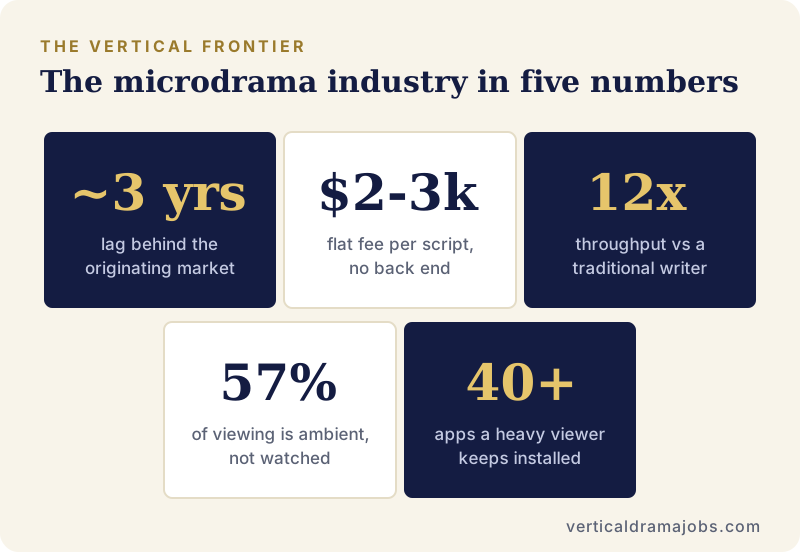 Figure: The five headline numbers from The Vertical Frontier, Working Paper No. 1. The three-year lag is a directional estimate from the aggregate synthesis, not audited data.
Truth 1: Is the future of vertical drama already written somewhere else?
Mostly, yes. The format was born in China, and other markets followed in sequence at a lag of roughly three years. Every phase the newer markets are entering, China already left: the explosion of apps, the consolidation, the shift from paid episodes toward ad support, the arrival of AI-generated content, and the widening of genre.
So the best forecasting tool in micro drama is to look at what China did about three years ago. Much of what feels like uncertainty is a timeline already published in another language.
Newer markets also skip stages. The Middle East never had a pure paywall era and launched straight into a hybrid of subscription, brand integration, redistribution and social. Latin America went from localization to original IP in about eighteen months, a trip that took the US closer to three years. Markets that develop after the lessons are public may need one year to mature, not three.
Full guide: Vertical drama market growth by country: China, the US, MENA and Latin America.
Truth 2: Why do vertical drama cliffhangers hit at episode 10?
Because the paywall sits at episode ten. Every writer in every market teaches the same shape: ten-episode blocks, a detonation at episode ten, and everything before it built to serve that moment. The business boundary and the story boundary are the same line.
This may be the first narrative form whose grammar came from a payment mechanism instead of from artists. Three-act structure came from theater, and vertical drama ran it backward. The monetization model arrived first, imported whole from serialized web fiction, and the craft grew up around it. The paper calls the result "scar tissue around a coin slot."
If you write for this market, know that changing the monetization model changes the grammar. Ad-supported episodes don't need a detonation at episode ten. They need retention spread evenly across the run. The instincts being drilled into writers this year have an expiry date.
Full guide: Why vertical drama cliffhangers hit at episode 10.
Truth 3: What actually protects anyone in micro drama?
Ask each role what protects it from being commoditized. Writers say human authorship. Actors say devoted followings. Platforms say capped founder communities. Casting directors say recurring stars. Every answer reduces to the same asset: a human being the audience has a relationship with.
Shows buy customers for a parasocial relationship, and the relationship holds the value. An actor with a subscriber base survives a platform collapse. A platform with a real community survives a content drought. A show survives nothing, because it's spent media the day it airs.
Audience behavior backs this up. Heavy viewers keep dozens of apps installed to follow specific performers, treating the platform as a container and subscribing to the face. Even impersonators posing as performers prove the point, since fraud gathers around what's valuable. The most undervalued asset in the industry is the mid-tier performer with a real audience and no representation.
Full guide: Why vertical drama actors with an audience outlast platforms.
Truth 4: Where is micro drama growing next?
Look where the ad test money is piling up, then read it backward. Ad-intelligence data puts parts of Western Europe among the heaviest creative-testing zones on earth. Operators in those same markets call them dead: little appetite, few platforms, audiences who would rather watch traditional formats.
Both are right. Platforms don't buy heavy tests where audiences already converted. They buy them where audiences haven't. Intense testing marks an unconverted market, and quiet spend marks a mature one.
Most analysts read ad spend as a heat map of where the action is. In vertical drama it's closer to a map of where platforms are still losing. Watch where test spend concentrates and you're watching platforms nominate the next market, by the paper's directional estimate about a year before it converts.
Full guide: Vertical drama ad spend and the next growth market.
Truth 5: How much do vertical drama writers get paid, and why does it stay that way?
In every market the writer's deal is the same: a flat fee, no ownership, no participation. The going rate is around $2,000 a script, holding even on titles that clear hundreds of millions of views. Writers with a track record push to $3,000, sometimes higher. One check, no claim on what the show earns.
That deal is extractive, and reform is overdue. But the missing back end is also what makes the machine fast. No residuals means no residual accounting, no profit-definition fights and no chain-of-title tangles. A platform can commission a series in a week because the paperwork is one page. A writer can take on a dozen a year for the same reason, which the paper puts at roughly 12 times the annual output of a traditional TV writer.
Formal pay is arriving. SAG-AFTRA's Verticals Agreement set floors of $250 a day for leads and $164 for other performers, and the WGA ruled the work covered by its basic agreement. Participation and velocity trade against each other, and nobody has priced that trade yet.
Full guide: Vertical drama writer pay: flat fees and no residuals explained.
Truth 6: Is it too late to get into vertical drama?
Not yet, but the door is on a timer. "No gatekeepers" is the industry's most repeated promise, and almost every practitioner's own story disproves it. A market's first specialist casting director appears, and that's a gate. A physical marketplace for distribution appears, and that's another. Award shows, unions, standard contracts, detailed briefs and paid training are gates too. Each one raises the floor a newcomer has to clear.
The paper's directional estimate is that openness has a half-life of roughly twelve to eighteen months per layer, and the layers close in the order they opened. Acting opened first, then casting formalized. Distribution opened, then the marketplace formalized. Writing is formalizing now. Platforms come after.
Practitioners who took a project from production to distribution saw licensing terms that looked generous at the start tighten by the time it finished. The market restructured inside one production cycle. That's not villainy, just how young markets mature.
You can see which gate closes next, so move before it does.
Full guide: Vertical drama has no gatekeepers, for now.
Truth 7: Why are vertical drama budgets so low?
Count the second jobs. A casting director who runs a needlework business. Performers who wait tables or manage properties. A self-funded producer with prior companies behind her. Crews working reduced rates for belief and a good wrap party. Writers juggling eight scripts because no single one pays a living.
Lean budgets, often under seven figures and rarely far above mid six figures, work because the workforce funds them from somewhere else. The cost advantage comes from the sector's immaturity, and it eats itself. As the sector professionalizes through unions, standards and fair-fee advocacy, which its best people are rightly fighting for, the subsidy withdraws and budgets drift back toward traditional levels.
The demand side mirrors it: an audience watching in the gaps of the day. Subsidized labor on one side of the camera, fragmented attention on the other.
Full guides: the supply side in Why vertical drama budgets are so low, and the demand side in Who watches vertical drama.
Truth 8: Is vertical drama really a video format?

Less than you'd think. The episode often runs while the viewer does something else, the way an older generation kept a radio serial going.
The craft rule in micro drama is total on-the-nose clarity: every want and threat spoken aloud, no subtext, because the swipe punishes ambiguity. Some committed viewers even describe rewatching favorites as re-listening. The rule was adopted to survive a distracted glance, and it produced audio-complete storytelling, possibly the first video form whose stories survive intact with the screen face down.
That opens three things nobody has claimed. A catalog that works by ear is a podcast-adjacent library nobody distributes as audio. Screenless listening is an engagement mode nobody measures or monetizes. And accessibility for blind and low-vision audiences comes nearly free when the dialogue narrates its own action.
Full guide: How people really watch vertical drama.
The eight truths at a glance
| Truth | What most people assume | What the synthesis shows | Who should care most |
|---|---|---|---|
| 1. Clock | Each market grows on its own curve | Markets trail China by about three years, and late markets skip stages | Producers, platform staff |
| 2. Grammar | Cliffhanger structure is pure craft | The paywall at episode ten set the structure | Writers |
| 3. Moat | The show is the asset | The audience relationship is the asset | Actors, casting |
| 4. Spend | Heavy ad spend means a hot market | Heavy test spend marks a market not yet converted | Producers, marketers |
| 5. Velocity | Flat fees are just a bad deal | Flat fees are also what make the industry fast | Writers |
| 6. Gates | There are no gatekeepers | Gates close on a schedule, in order | Everyone breaking in |
| 7. Subsidy | Low budgets are a structural edge | Low budgets borrow from the workforce | Producers, crew |
| 8. Audio | Micro drama is a visual format | Much of it works as audio | Writers, sound crew |
What the eight truths say together
Read together, they describe one industry. Its grammar is younger than its business model, its openness is decaying on a schedule, and its cost advantage is borrowed from its own workforce. Its next markets will arrive faster than the last ones did, and its durable assets are human.
The doors are closing on roughly the same clock as the consolidation already underway. The paper says it plainly: "The format is settling into its mature shape now. The good positions are being taken now. Same deadline on both." This isn't a market where you can wait and see.
How the paper was made
The Vertical Frontier is an aggregate synthesis. It draws on the first edition of the Micro Drama Summit, with 19 speakers, on structured operator interviews across five markets, and on independent research papers read against one another. No finding is attributable to a single contributor, and no speaker is named. Where the paper makes estimates (the market lag, the ad-spend read and the timing of gates closing), it says so. Charts show the relationships described, not audited data.
What this means for your career
Writers
Learn the episode-ten structure, because it's what gets you hired today. Also practice writing for even retention across a run, because ad support is coming. Take the volume while the flat-fee market is open, and track how the WGA position develops. Write dialogue that works with the screen face down. Our vertical drama script guide covers the fundamentals, and vertical drama writer jobs covers the hiring side.
Actors
Your following is your moat. Build an audience that follows you rather than the app. Protect your identity, because impersonators target performers worth impersonating. If you have an audience and no representation, you hold something many people want, so understand its value before you sign anything. Our vertical drama actor pay guide covers rates and the Verticals Agreement.
Crew and producers
Budget honestly. If a production only works because people are working below their rate, it won't hold as the industry professionalizes. Watch markets with heavy ad testing, because they may convert next. Sound and dialogue craft matter more in this format than most people assume.
Frequently asked questions
What is The Vertical Frontier?
A 2026 paper by Chi Odogwu, published by Vertical Film School and Vertical Drama Jobs, that sets out eight non-obvious truths about the microdrama industry.
What is the future of vertical drama?
If the three-year lag holds, Western markets are heading into consolidation, ad support, more AI-generated content and wider genres. Newer markets may get there faster by skipping stages (see Truth 1).
Are micro drama trends the same in every country?
The phases are similar, but the speed varies. The Middle East skipped the pure paywall era, and Latin America reached original IP in about eighteen months.
Is vertical drama a good career in 2026?
It can be, especially if you move before the next gate closes. Pay is still low and mostly flat-fee, but volume is high and formal agreements are arriving. The people best placed long term build a real audience relationship or a reputation for speed and quality.
Sources and notes
- Writer pay: prevailing rates of $2,000 to $3,000 per script for a full series screenplay. Flat work-for-hire deals with no residuals were documented on Scriptnotes (John August, September 2025).
- Formalizing pay: SAG-AFTRA's Verticals Agreement, signed October 13, 2025, for productions under $300,000, sets minimums of $250 a day for leads and $164 for other performers, about 20 percent of standard scale (Variety and Deadline, October 2025; Mondaq, 2026). The WGA ruled this work covered by its minimum basic agreement (John August; Variety).
- Ambient viewing: 57 percent of viewing in ambient mode, per Micro Dramas: The India Story (Meta and Ormax Media, fieldwork November 2025 to January 2026, 2,000 respondents).
- Following the face: heavy viewers follow specific performers across apps, some carrying upwards of 40 vertical apps (Vertical Drama Love, via Deadline, December 2025).
- Market-lag intervals (Truth 1), the creative-testing read (Truth 4) and the layer-closing cadence (Truth 6) are the author's directional estimates.
- Figures are illustrative of the relationships described and are directional rather than audited.
More from The Vertical Frontier
- Vertical drama market growth by country
- Why vertical drama cliffhangers hit at episode 10
- Why vertical drama actors with an audience outlast platforms
- Vertical drama ad spend and the next growth market
- Vertical drama writer pay: flat fees and no residuals
- How long the no-gatekeepers window stays open
- Why vertical drama budgets are so low
- How people really watch vertical drama
- Who watches vertical drama