How to Build a Following as a Vertical Drama Actor (and Why Your Audience Is the Only Real Moat)

The only durable asset in vertical drama is a human being the audience has a relationship with. Shows come and go, platforms rise and fold, but an actor with a following carries it to the next app, the next series and the next deal.
That sounds soft. It's actually the most practical career fact in micro drama right now, and it decides who keeps working when the market reshuffles.
This guide comes from The Vertical Frontier, Working Paper No. 1, a synthesis of Micro Drama Summit sessions, operator interviews across five markets and independent research. It covers Finding 03, the moat, and what it means if you act, cast, write or produce.
Key takeaways
- Ask any role in vertical drama what protects it from being replaced, and every answer reduces to the same thing: a person the audience feels connected to.
- Shows aren't the business. They buy customers for a relationship, and the relationship holds the value.
- Heavy viewers keep dozens of apps installed (some more than 40) to follow specific performers.
- An actor with a fan base survives a platform collapse. A show is spent media the day it airs.
- The most undervalued asset in the industry is the mid-tier performer with a real audience and no representation.
What protects a vertical drama career from being replaced?
Ask each role what keeps it from becoming a commodity and the answers differ on the surface. Writers say human authorship. Actors say devoted followings. Platforms say capped founder communities, a small group of early, committed users. Casting directors point to the recurring star, the face audiences treat as real. And the people who reformat existing film and TV libraries for vertical say it's the trust audiences already place in familiar IP.
Look closer and they're all the same answer. Each describes a connection between a viewer and a person, or a person-shaped story: the writer's voice, the actor's face, the founder's community, the star fans recognize, the familiar characters from a library.
That connection is the moat.
Why shows are not the product in micro drama
 If you think in titles, this part is uncomfortable. In vertical drama, the show is closer to a marketing cost than an asset.
A show gets made, released and watched. Then it's done. A series can rack up enormous view counts and leave nothing behind for the people who made it beyond their fee.
What a show actually does is recruit viewers into a relationship with the people on screen, and that relationship keeps paying after the show is over. The paper puts it in three lines:
- An actor with a real subscriber base survives a platform collapse.
- A platform with a real community survives a content drought.
- A show survives nothing.
For your career, that changes where the effort goes. Each role you book is worth its fee, plus whatever share of its audience follows you out the door.
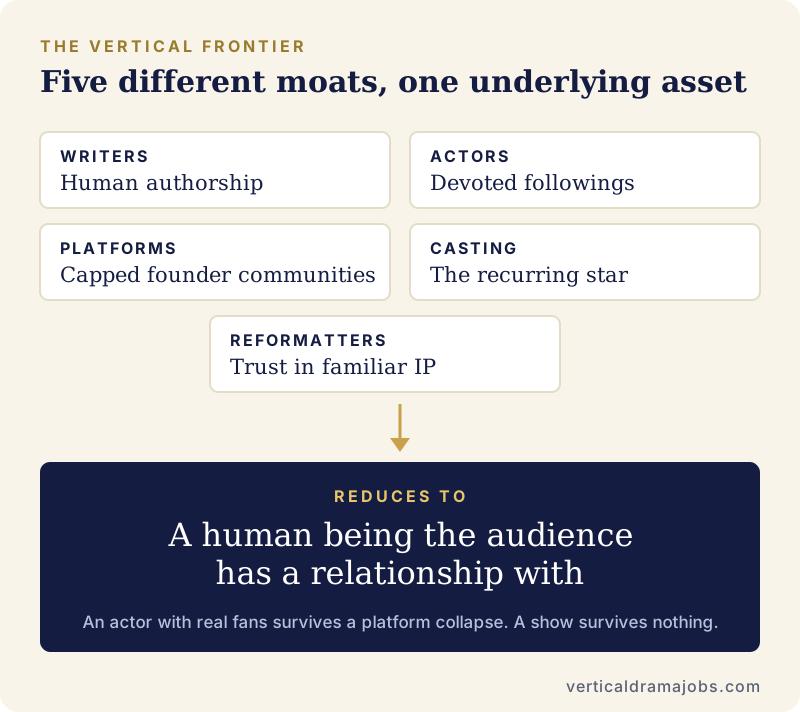 Figure: Every role's answer to "what protects you" reduces to one asset, a human being the audience has a relationship with.
Why do fans follow micro drama actors across apps?
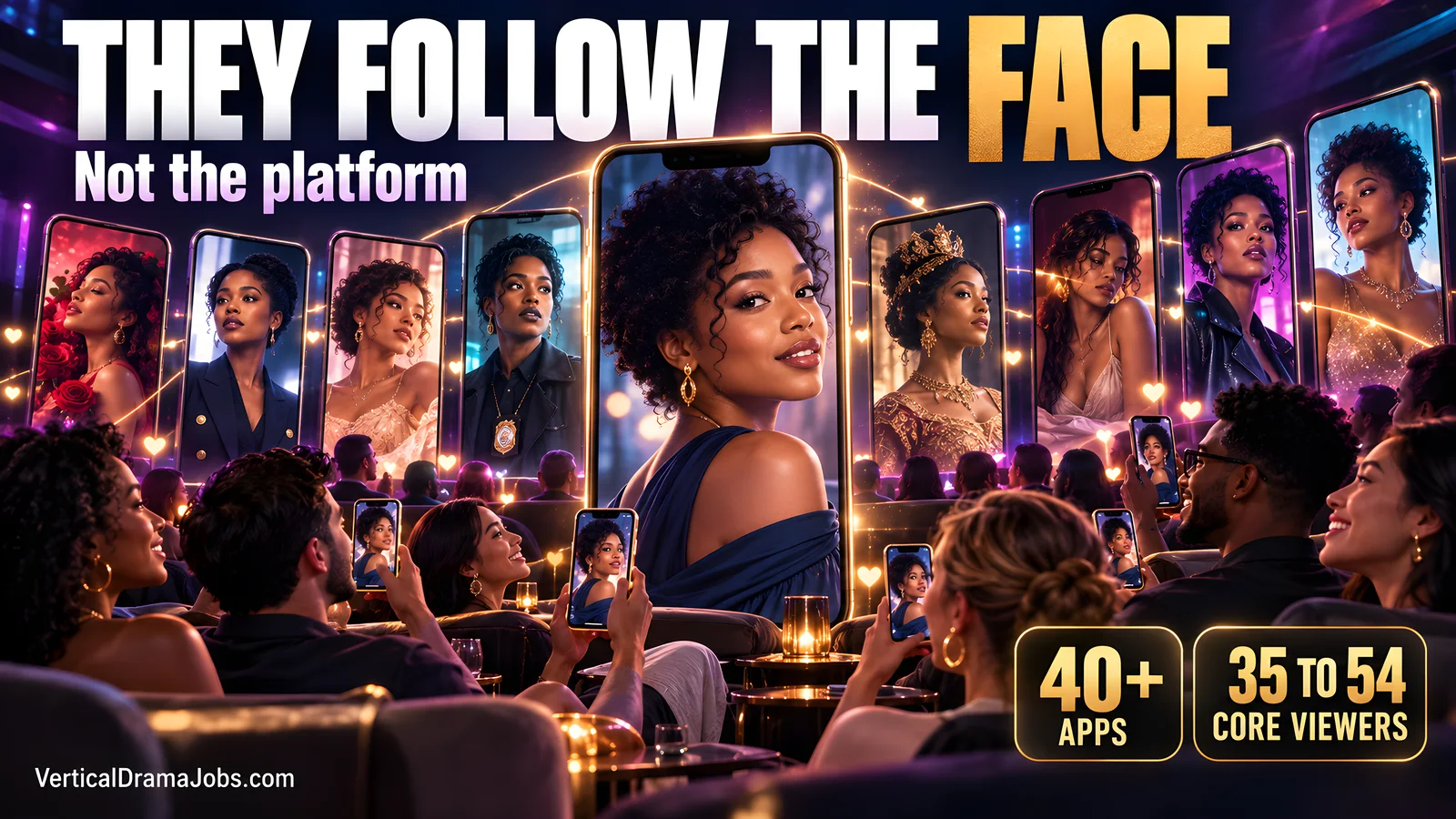 The audience research backs this up with behavior, not just opinion. One fan survey found that the most engaged viewers are led primarily by their favorite actors, with some carrying upwards of 40 vertical apps on their phones. They install an app because the actor is in something there.
So the platform is a container and the viewer subscribes to the face. The tools these viewers ask for are organized by people, not titles. They want to find everything a specific performer has done, wherever it lives.
The app spends money to acquire a viewer, but the viewer's loyalty attaches to the actor. When the actor moves, a slice of that loyalty moves too.
Who is this audience?
The core Western micro drama audience skews female, roughly 25 to 65, concentrated in the 35 to 54 range, with heavy crossover from romance-novel readers. It's also broadening, with the male share on some platforms rising toward 30 percent. For more on that shift, see our guide to the male audience in verticals.
Romance readers have a long habit of following authors from book to book, and the habit carries over. Viewers who follow a favorite writer across a shelf will follow a favorite actor across a phone.
The counterfeit problem proves the point
There's a darker signal too. Impersonators pose online as accessible versions of popular vertical drama performers.
Fraud concentrates around whatever is worth stealing, and scammers impersonate performers rather than shows or apps. That tells you where the value sits.
It's also a practical warning. If you have a following, someone may try to borrow it. A clear, consistent and verifiable presence makes it easier for fans to know which account is you.
Do vertical drama actors need an agent?
It's one of the most common questions in the space, and the paper's answer is pointed. The most undervalued asset in this industry is the mid-tier performer with a real audience and no representation. She owns, unmanaged, the exact moat everyone else is renting.
That doesn't say you must have an agent to work. It says that if you have an audience, you're holding something valuable, and most people holding it right now aren't pricing it, protecting it or using it in negotiations.
Representation versus self-management
Here's a rough comparison of your options, a framework rather than a ranking.
| Question | Self-managed performer | Represented performer |
|---|---|---|
| Who tracks the value of your following? | You do, or nobody does | Shared with your rep |
| Who brings your audience into a negotiation? | You have to raise it yourself | Your rep can raise it for you |
| What do you keep? | All of your fee | Your fee minus your rep's share |
| Biggest risk | Leaving value on the table because nobody prices your audience | Paying for help that doesn't understand vertical audiences |
| Works best when | You are organized and comfortable talking money | Your following is large enough to be a bargaining chip |
Knowing what you have matters more than having an agent. An actor who understands that her audience is the asset will negotiate differently, with or without help. For pay context, see how much vertical drama actors make in 2026.
How the union floor fits in
SAG-AFTRA's Verticals Agreement, signed October 13, 2025, covers productions under $300,000. It sets minimums of $250 a day for leads and $164 for other performers, about 20 percent of standard SAG-AFTRA film and TV scale.
Analysts noted that this floor can land below what non-union productions already pay experienced leads. A floor set in an immature market can sit under the going rate.
For the moat argument, the point is that a union minimum protects a baseline and doesn't price your audience. An actor whose fans follow her across apps is worth more than the floor, and the gap between the two is the part she has to argue for. We break down the deal structures for writers and performers in why vertical drama writers get a flat fee and no residuals.
How to build a following as a vertical drama actor
The paper doesn't hand out a social media playbook, and we won't invent one. But the finding points at a few principles.
Make yourself findable by name
Fans index by people, not titles. If a viewer finishes a series and searches for you, they should find you. Use one consistent name across your work and your public profiles, because if a credit lists you differently from your accounts, fans lose the trail.
Own a channel the platforms don't
A following that lives only inside one app's comment section isn't yours. Build somewhere you can reach people directly, so that when an app folds, your audience doesn't fold with it.
Treat every role as audience acquisition
Each series is a chance to recruit viewers into a relationship with you. Recurring characters, roles in popular tropes and repeat work with the same producers all give the same viewers more chances to find you again. Choose work partly on whether it builds your following, not only on the fee.
Keep your public presence verifiable
Impersonators target popular performers, so a consistent and clearly authentic presence protects both you and your fans.
Know your numbers before you negotiate
If fans follow you across apps, you can bring that into a conversation with a producer. Don't oversell it. Just know it and say it.
What this means for your career
Actors
Your following is your career insurance. Platforms will consolidate and some will close, but your relationship with your audience moves with you. Build it on purpose, keep it findable and price it into your deals. If you're mid-tier with a fan base and no representation, the paper is describing you as undervalued. Act like it. Browse current casting calls with that in mind.
Writers
Human authorship is your version of the moat. A recognizable voice that audiences seek out is worth more than a clean script nobody connects to a name. Credit, consistency and a public body of work all help readers find you again. If you're starting out, see vertical drama writer jobs: how to break in and what they pay.
Producers and casting
The recurring star brings viewers back, so casting decisions are audience decisions. A performer with a following brings customers to a show before it launches. Building repeat relationships with performers audiences already love is a strategy, not a favor.
People at platforms
A platform with a real community survives a content drought. Investing in community, and in the performers audiences follow, protects the business in a way a single hit can't.
Frequently asked questions
How do I build a following as a vertical drama actor?
Be easy to find by name, keep a channel you control outside any single app, and treat each role as a way to recruit viewers. Consistency beats volume of posting. The full list is in the section above.
Do vertical drama actors need an agent?
Not necessarily. The paper doesn't say representation is required to book work. If you have fans, just make sure someone, you or a rep, is pricing that into your deals.
Why do fans follow micro drama actors across apps?
They subscribe to the face, not the platform. The fan survey above covers the details.
What happens to my audience if a vertical drama app shuts down?
If your following lives only inside that app, much of it goes with it. If fans can find you independently, your audience survives. That's why the paper calls the performer relationship the moat.
Does the SAG-AFTRA Verticals Agreement pay actors for their following?
No. It sets floors, and anything your audience is worth above them is part of what you negotiate.
Who watches vertical dramas?
Mostly women 35 to 54, with a growing male share. See the audience section above, or our full guide on who watches vertical drama.
Sources and notes
- The Vertical Frontier, Working Paper No. 1 (2026), Chi Odogwu, published by Vertical Film School and Vertical Drama Jobs. Finding 03, an aggregate synthesis of Micro Drama Summit sessions, operator interviews across five markets and independent research. No finding is attributable to any single contributor.
- Following the face: Vertical Drama Love fan survey, via Deadline, December 2025.
- Audience demographics: Jen Cooper / Vertical Drama Love survey of 1,600+ viewers, via Digital Content Next and Deadline, 2025 to 2026. Male share: Holywater and Owl & Co, The State of Microdrama 2026, via Variety.
- SAG-AFTRA Verticals Agreement: Variety and Deadline, October 2025; Mondaq, 2026.
- Figures are illustrative of the relationships described and are directional rather than audited.
More from The Vertical Frontier
- The Vertical Frontier: 8 truths about the microdrama industry
- Who watches vertical drama? Audience demographics for 2026
- Vertical drama has no gatekeepers. How long will the window stay open?
- Why vertical drama writers get a flat fee and no residuals
- Why vertical drama budgets are so low: the hidden labor subsidy