Where Is Micro Drama Growing Next? Read the Ad Spend Backwards

Micro drama is growing next wherever platforms are spending heavily to test ads and audiences haven't converted yet. Big test budgets don't mean a market is booming. They mean platforms are still trying to win it.
Most people read advertising spend as a heat map of where the action is. In vertical drama it works more like a map of where platforms are still losing. That makes it one of the best early signals of the next market to turn.
This guide comes from The Vertical Frontier, Working Paper No. 1, a synthesis of Micro Drama Summit sessions, operator interviews across five markets and independent research. It covers Finding 04, spend, and how to use it if you want to work where the format is heading instead of where it has already been.
Key takeaways
- Ad-intelligence data puts parts of Western Europe among the heaviest creative-testing zones on earth for vertical drama, yet operators there call the market dead.
- Both readings hold. Platforms test hardest where audiences haven't converted.
- Intense testing marks an unconverted market. Quiet spend marks a mature one.
- Watching where test spend piles up shows you which market platforms are nominating next, about a year before it converts.
What is creative-testing spend in vertical drama?
Vertical drama platforms find viewers through paid ads. Before they put serious money behind a campaign, they test. They run many ad versions, hooks and clips against an audience to see what makes people click and keep watching.
That testing costs money, and ad-intelligence tools can show where in the world platforms are running the most of it. The paper calls these creative-testing zones.
The obvious assumption is that heavy testing means a hot market: platforms are spending, so the audience must be there. The paper finds the relationship runs the other way.
Is vertical drama growing in Europe?
The finding started with a puzzle. By the ad-intelligence numbers, Europe looks like one of the busiest places in micro drama. Operators working in those same markets describe them as dead. They report no appetite, few platforms, and audiences who would rather watch traditional formats.
Both are true at once. Platforms don't spend heavily on testing where audiences have already converted, because there they know what works. They have the hooks, the genres and the audience profiles, so they spend efficiently. Heavy testing happens where they still don't know, which means where the audience hasn't turned yet.
So Europe's big test budget doesn't show that Europe has arrived. It shows a market that hasn't turned.
Why heavy ad spend signals an unconverted market
 Think of testing as the cost of not knowing. The less a platform knows about an audience, the more it pays to learn.
In a mature market the learning is mostly done, so spend gets quieter and more targeted. In an unconverted market the platform is still guessing and runs test after test. The spend is loud because the answers are missing. That gives you a simple rule:
- Intense testing marks an unconverted market, one where platforms are still guessing.
- Quiet spend marks a mature one, where they already know.
The paper's one-line version: heavy test spend marks the next market.
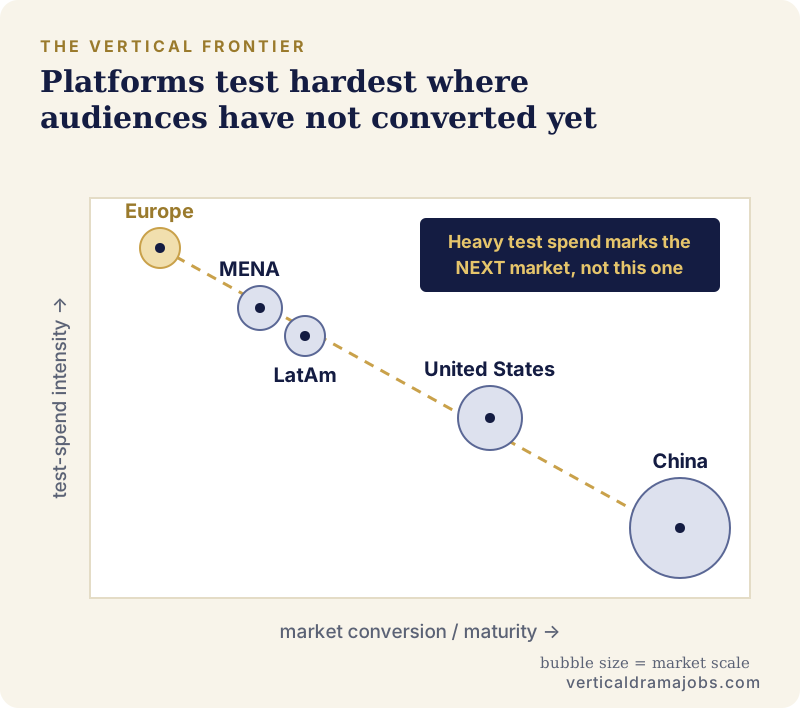 Figure: Test-spend intensity against market conversion, bubble size showing market scale. Europe sits high on spend and low on maturity; China sits low on spend and high on maturity; MENA, Latin America and the United States fall in between along a downward trend. Directional estimate from the aggregate synthesis, not audited data.
How to read the map: market by market
 The chart places five markets along that downward line. The table below uses only what the paper describes.
| Market | Test-spend intensity | Market maturity | Market scale (bubble) | How to read it |
|---|---|---|---|---|
| Europe | High | Low | Small | Platforms still trying to win it; not converted |
| MENA | High-ish | Low to mid | In between | Being actively contested |
| Latin America | High-ish | Low to mid | In between | Being actively contested |
| United States | Mid | Mid | In between | Partway along the curve |
| China | Low | High | Largest | Mature; spend is quiet because the market has turned |
China is where the format started, years ahead of everyone else. Low spend there doesn't mean the platforms gave up. The learning is done. The United States sits in the middle, and Europe sits at the far end, which makes it a candidate for what turns next. These positions are directional. They show a relationship, not audited measurements.
Where is micro drama growing next?
Watch where test spend piles up. When it concentrates in a region, you're watching platforms nominate the next market, about a year before it converts.
The signal gets sharper next to Finding 01, the clock. The format moved from China to other markets at a lag of roughly three years, but newer markets aren't just following slowly. They're skipping stages.
- The Middle East never had a pure paywall era. It launched straight into a four-stream hybrid: subscription, brand integration, redistribution and social.
- Latin America compressed the trip from localization to original IP into about eighteen months. The US took closer to three years.
Markets that develop after the lessons are public don't need three years to mature. They may need one. So when a region shows heavy test spend, it may convert much faster than the Western curve suggests, and the paper warns that if you expect the slow curve, you'll arrive two years late. For the full timeline, read the vertical drama global market timeline.
Micro drama in Latin America and the Middle East
Both regions show elevated test spend and low-to-mid maturity on the chart, and both have already moved faster than the US did. The paper describes the next breakout region as one where everything the industry now knows gets applied at once, to an audience already fluent in serialized melodrama.
Micro drama in Europe
Europe is the clearest case of the contrarian signal: heavy testing, little conversion, operators calling it dead. That's the profile the paper says to watch, and it has preceded conversion elsewhere. It isn't a promise that Europe will turn. The timing is a directional estimate, not a guarantee.
Why most analysts read ad spend the wrong way
Most market analysis treats spend as a scoreboard. More money in means more activity and more opportunity right now.
In vertical drama that reading can send you to the wrong place at the wrong time. Chase the loudest spend expecting a boom today and you may find what the operators in Europe describe: few platforms and little appetite. Read spend as a forward indicator and the plan changes. The loud regions are where the next opportunity is forming. The quiet ones are where the market has already settled, along with its jobs, its standards and its gatekeepers.
That connects to another finding in the paper. Openness in this industry is a phase, and gates close in roughly the order they opened. A market that hasn't converted yet is a market whose gates haven't formed. See vertical drama has no gatekeepers, for now.
What this means for your career
Producers and studio people
If you're deciding where to develop, co-produce or pitch next, don't only look where audiences are already paying. Look where platforms are testing hard. They're hungry for content that works there, and the people who arrive early help define what working looks like. Browse producer jobs and studio jobs with that lens.
Writers
A market that hasn't converted is still working out what its audience wants. Writers who know the format's proven structures and can adapt them to a new audience's taste are useful early, and language skills and cultural fluency count for more while a market is forming. Start with how to write a vertical drama script.
Actors
Your following is portable, and new markets need faces audiences will follow. The paper's moat finding says the performer relationship is the durable asset, so building it before a market converts puts you ahead of the wave. Read how to build a following as a vertical drama actor.
Marketing and growth roles
If you work in user acquisition or creative for a platform, this is your daily reality. Heavy testing is a symptom of not knowing, so the people who shorten the learning curve by finding the hooks and creative that convert a new audience are the ones a platform needs most in exactly those markets. Browse remote jobs for marketing and growth openings.
Everyone
Heavy test spend shows up about a year before a market converts. Use the ad map as a calendar, and that year is your lead time.
Frequently asked questions
Where is micro drama growing next?
Wherever platforms are concentrating heavy creative-testing spend. On the paper's directional chart, Europe stands out, with MENA and Latin America also elevated.
Is vertical drama popular in Europe?
Not yet, by operators' accounts. They describe little appetite and audiences who prefer traditional formats, even as the ad data shows platforms testing hard there.
Why would platforms spend more on ads in a market that isn't working?
Testing is how they learn what works. Where they already know, spend gets quieter. Where they're still guessing, they test more.
Does high micro drama advertising spend mean a market is booming?
No. In this industry it usually means the opposite. China, the most mature market, has the quietest spend.
How fast can a new micro drama market grow?
Faster than the first ones did. See the Latin America and Middle East examples above. The paper suggests newer markets may need one year to mature, not three.
How accurate is the ad spend signal?
It's a directional estimate from the aggregate synthesis, not audited data. Use it to decide where to look. It won't give you a precise forecast.
Sources and notes
- The Vertical Frontier, Working Paper No. 1 (2026), Chi Odogwu, published by Vertical Film School and Vertical Drama Jobs. Finding 04 (spend) and Finding 01 (clock), an aggregate synthesis of Micro Drama Summit sessions, operator interviews across five markets and independent research. No finding is attributable to any single contributor.
- The creative-testing read (Finding 04) and the market-lag intervals (Finding 01) are the author's directional estimates from the aggregate synthesis, not audited measurements.
- Figures are illustrative of the relationships described and are directional rather than audited.
More from The Vertical Frontier
- The Vertical Frontier: 8 truths about the microdrama industry
- Vertical drama global market timeline: China, the US, MENA and Latin America
- Vertical drama has no gatekeepers. How long will the window stay open?
- Who watches vertical drama? Audience demographics for 2026
- How to build a following as a vertical drama actor