How Do Micro Drama Apps Make Money? CAC, Payback and Cohort Economics Explained

Micro drama apps make money from cohorts rather than first sales. The cost of acquiring a viewer routinely beats what that viewer pays for the first block of episodes, so every new group of viewers starts at a loss. The business is the day that group's later spending climbs back above what it cost to win them.
Read as a single transaction, that looks like a failing business. Read as a cohort, it's the business. The first purchase exists to establish the title. The return comes later, in the episodes a viewer keeps paying for over the following weeks, and in the second title they open already converted.
This guide comes from The Vertical Frontier, Volume Two: Where the Money Is Hiding, an aggregate synthesis of first-hand industry discussions, structured interviews in five markets, independent audience research and outside industry data. It covers two of the three moves in Finding 01: the first sale that is built to lose money, and the greenlight that lives on the demand side. For the opening of that finding, read what percentage of micro dramas succeed. For the full first volume, see The Vertical Frontier: 8 truths about the microdrama industry.
Key takeaways
- In micro drama, customer acquisition cost (CAC) routinely beats what a new viewer pays for the first block. The first sale is a planned loss.
- The unit that matters is the lifetime of a cohort, and the number that governs the industry is the day that lifetime crosses back above its acquisition cost.
- Judging a title by its opening return misreads it in both directions: you kill cohorts about to pay back and scale ones whose curve never crosses.
- The platform holds the payback curve, and the creator usually can't see it.
- Acquisition and distribution decide outcomes, so the key questions can and must be answered before production. A concept that can't attract early signal should be shelved.
How do micro drama apps make money?
The model has three stages, and only the last one makes money.
First, the platform pays to acquire a viewer, usually through paid ads built around a hook. Second, that viewer pays to keep watching. Third, the viewer keeps buying: more episodes of the same title over the following weeks, then a second title, then a third.
The trap is mistaking stage two for the sale. What a platform spends to win a viewer is routinely more than that viewer pays for the first block, so on that one transaction the platform is underwater. That's on purpose. The first purchase turns a stranger into a paying viewer of this title, and once someone has paid once, they're far easier to sell to again, for the rest of this show and for the next one they open.
So the money is made in the tail of the relationship. That's also why paywall placement matters so much to story structure, covered in why vertical drama cliffhangers hit at episode 10.
What is customer acquisition cost in vertical drama?
CAC is what a platform spends to turn one stranger into one paying viewer. In vertical drama, most of it is ad spend: the hook-driven clips you see in social feeds.
The size of CAC matters less than how it compares with the first payment. That one comparison explains why opening numbers mislead so many people inside the business.
| Way of reading a viewer | What it measures | What it concludes |
|---|---|---|
| As a single transaction | First payment minus acquisition cost | The business is losing money on every viewer |
| As a cohort | Total spending over weeks and later titles, minus acquisition cost | The business works if the cohort crosses back above zero |
| As a portfolio | Cohorts across many titles | The platform wins on the cohorts that pay back and cuts the ones that don't |
What is cohort payback in micro drama?
 A cohort is a group of viewers acquired around the same time, often through the same campaign or title. Cohort payback is the point at which that group's total spending catches up with what it cost to acquire them.
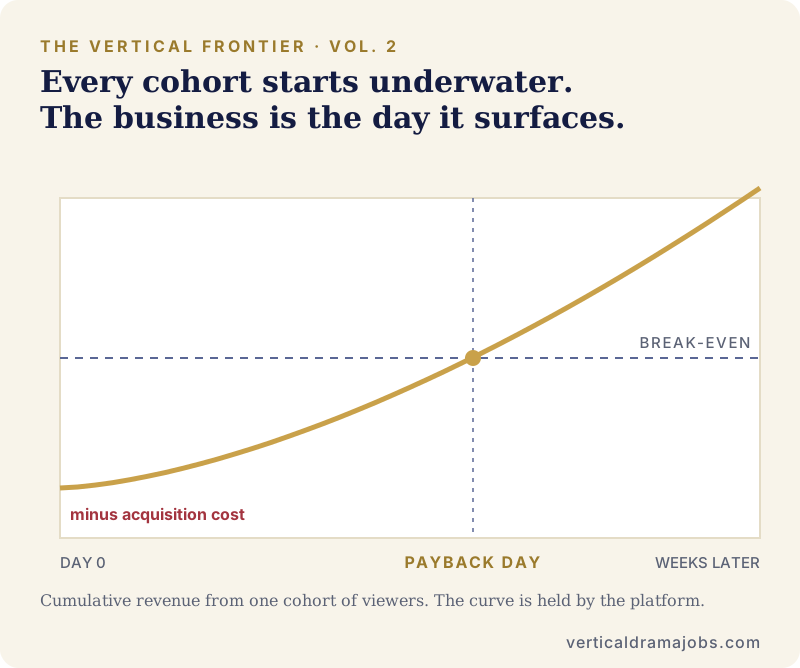 Figure: Every cohort starts underwater at minus its acquisition cost. The business is the day it surfaces, and the curve that decides it is held by the platform. Directional estimate from the aggregate synthesis, not audited data.
Picture the curve. On day one the cohort sits below zero, at minus whatever the platform spent to acquire it. As viewers keep paying for episodes, the curve climbs, and if it climbs far enough it crosses zero. That crossing is the payback day. Everything after it is the cohort's actual return.
Volume Two calls the payback day the number that governs the industry, ahead of the first sale or the opening weekend.
Why judging a micro drama by its opening numbers is a mistake
This is where operators lose money. Judge a title by its opening return and you misread it in both directions.
You kill titles that were about to work. A cohort that's deep underwater in its first days can look like a failure. If its curve is climbing at the right pace, it may be days or weeks from payback. Cutting ad spend there throws away the cost already sunk into viewers who were on track to pay it back.
You scale titles that never will. A strong opening can hide a curve that flattens early. Pour more acquisition money into that title and you buy more cohorts that never surface. The bigger the push, the bigger the loss.
| Opening looks | Curve actually does | Mistake if you judge by opening | Right call |
|---|---|---|---|
| Weak | Climbs steadily toward zero | Kill it too early | Keep funding until payback |
| Strong | Flattens before zero | Scale it into a loss | Cut spend, protect the portfolio |
| Strong | Climbs past zero | None | Scale it |
| Weak | Flattens early | None | Cut it |
Ask where a title's cohort curve is heading and when it crosses, instead of how it opened.
Who controls the payback curve?
The platform does. That's one of the most important lines in Volume Two for anyone who makes the shows.
The platform sees the acquisition spend, the episode-by-episode payment data and the long tail of each cohort. The creator, in most cases, sees none of it. So the decision that matters most, whether a title keeps getting acquisition money, is made on a curve the people who wrote, cast, shot and edited the show can't see. That gap is its own finding in Volume Two, with its own guide: vertical drama creator data and pay transparency.
Why the micro drama greenlight lives on the demand side
Most makers have the same reflex: finish the thing, then find its audience. Vertical drama runs the other way.
Because acquisition and distribution decide outcomes, the decisive questions can be answered before a single scene is shot. Volume Two lists them:
- Will a platform feature this?
- Will the hook stop the scroll?
- Is this trope still converting?
In this market, those answers are the greenlight. Script coverage and budget don't enter into it.
How to test a vertical drama concept before production
 The practical version of the demand-side greenlight is a short sequence. You can adapt it to any team.
1. Start with the hook
Write the hook first: the premise, the opening beat and the moment that would stop a thumb mid-scroll. If you can't state it in a line or two, the concept isn't ready to test.
2. Check whether the trope is still converting
Tropes rise and tire. Before you build on one, find out whether it's still pulling viewers on the platforms you want to sell to. If it's fading, the concept starts at a disadvantage no budget fixes.
3. Find out whether a platform would feature it
Distribution decides who even sees a title. Test the concept against what a platform is actively looking for. A pitch no platform will feature is a show that has to buy every viewer the expensive way.
4. Look for early signal, then decide
You want a signal from the demand side before production money is spent: interest from a platform, a hook that holds attention, a trope that's still working.
5. If the signal doesn't come, shelve it
This is the hard part. Volume Two is blunt: a concept that can't attract early signal has been answered, and more money won't change that. Shelve it and test the next one instead of producing it and hoping the audience shows up. That habit separates operators who run a portfolio from those who fund one bet at a time.
| Supply-side greenlight | Demand-side greenlight |
|---|---|
| Finish the show, then find the audience | Find the signal, then make the show |
| Weak interest means it needs more money | Weak interest means the concept has been answered |
| One bet at a time | A portfolio of tested concepts |
| Shelving feels like failure | Shelving is the core discipline |
What this means for your career
Cohort economics and demand-side greenlights change what makes you useful on a vertical drama team, whatever your role.
Producers and development executives
Learn to talk about titles in cohort terms. When you defend or cut a show, talk about where its curve is heading. Test concepts against demand-side signal before you ask for production money, and be the person who can shelve a concept without drama. Those skills are rare, and teams that run portfolios need them. Browse producer jobs and studio jobs.
Writers
Your hook is the first thing tested, often before your script is. Get good at writing hooks and loglines that can be judged quickly on their own. If a concept gets shelved after a test, don't read it as a verdict on your writing. A writer who brings five testable hooks is more useful to a portfolio operator than one who brings a single finished script. See vertical drama writer jobs.
Editors and marketing teams
Acquisition clips sit at the start of every cohort, so the hook cut that stops the scroll is part of the CAC side of the equation. If you cut trailers or ad creative, learn which openings bring in viewers who keep paying, not just viewers who click. Find editor jobs on the board.
Actors
The platform decides which titles keep getting acquisition money based on cohort curves you can't see, so a title's survival is hard to predict from the set. Focus on what carries across titles: a reputation for reliable work and an audience that follows you. Browse casting calls.
Frequently asked questions
How do micro drama apps make money if the first sale loses money?
On the cohort, over time. See the three stages above: the loss on the first block is made back in later episodes and later titles.
What is a good customer acquisition cost for vertical drama?
There's no single good CAC. What matters is whether the cohort's lifetime spending crosses back above it, and how fast. A higher CAC can be fine if the curve crosses. A lower one can still lose money if it never does.
What is the payback day in micro drama?
The day a cohort's total spending catches up with what the platform spent to acquire it.
How do you test a vertical drama concept before production?
Ask the three demand-side questions first. If the concept can't attract early signal, shelve it and test the next one.
Can independent creators see cohort data for their vertical dramas?
Usually not. The platform holds the payback curve, and creators typically see little of the underlying data.
If you want the short version of where platform spend goes, read Micro Drama Summit's how microdramas make money guide.
Sources and notes
- The Vertical Frontier, Volume Two: Where the Money Is Hiding (2026), by Chi Odogwu: Finding 01, an aggregate synthesis of first-hand industry discussions, structured interviews in five markets, independent audience research and outside industry data.
- The relationships in this guide (acquisition cost against first payment, cohort lifetime, payback day, demand-side greenlight) are drawn from that synthesis. Volume Two cites no single public dataset for cohort curves, and none is implied here.
Figures are illustrative of the relationships described and are directional rather than audited.
More from The Vertical Frontier
- The Vertical Frontier, Volume Two: Where the Money Is Hiding
- What percentage of micro dramas succeed? Budget vs return
- How to finance a vertical drama: the capital stack
- Vertical drama retitling, discovery and word of mouth
- Vertical drama creator data and pay transparency
- Why vertical drama cliffhangers hit at episode 10
- Vertical drama ad spend and the next growth market