Why Do Vertical Dramas Have Different Titles on Different Apps? How Retitling Kills Word of Mouth

Vertical dramas have different titles on different apps because the industry retitles shows per platform and per ad campaign to win clicks from strangers. It works for acquisition. But the catalog ends up with no stable identity, so fans can't find a micro drama they loved, can't tell a new release from a rename, and can't send a friend to it.
That's the first of three hidden costs in how vertical drama gets marketed. The lurid ad style that pulls in new viewers also makes existing fans hide their habit. Hidden fans don't talk, and word of mouth, the only free acquisition channel in the funnel, goes quiet.
This guide comes from The Vertical Frontier, Volume Two: Where the Money Is Hiding, an aggregate synthesis of first-hand industry discussions, structured interviews in five markets, independent audience research and outside industry data. It covers Finding 05, "the acquisition engine is at war with the retention engine." For the market map underneath it, see The Vertical Frontier: 8 truths about the microdrama industry.
Key takeaways
- The title-and-ad system that acquires strangers so well also taxes the viewers who already converted, in three ways that compound.
- Findability: shows get retitled per platform and per campaign, so fans can't relocate a show or recommend it.
- Stigma: trope-stacked titles and shock-cut ads are the only face of the medium most non-viewers ever see.
- Word of mouth: a hidden fan refers nobody.
- Acquisition is measured to the impression. Referral, pride and findability are measured nowhere.
- The fix is cheap and old: a stable canonical identity under whatever discovery titles the campaigns need.
Why do vertical dramas have different titles on different apps?
Because the title is treated as an ad, not a name. Micro drama platforms lean on paid ads to acquire viewers, and a title that stops the scroll for one audience may flop with another. So the same show gets a new title per platform, then another per campaign, each tuned to win a click from someone who has never heard of it.
From the acquisition side, that looks smart. Every title gets tested, and the winner gets the spend. But nobody owns the show's identity across all those versions. The catalog has no permanent names.
From the viewer's side, it looks like chaos. The show she watched last month seems to have vanished. A "new" show turns out to be one she already finished. A friend searches for the title she mentioned and finds nothing, or finds a different show.
How retitling, stigma and silence compound
 The volume calls this a war between the acquisition engine and the retention engine. The three taxes don't sit side by side. Each feeds the next.
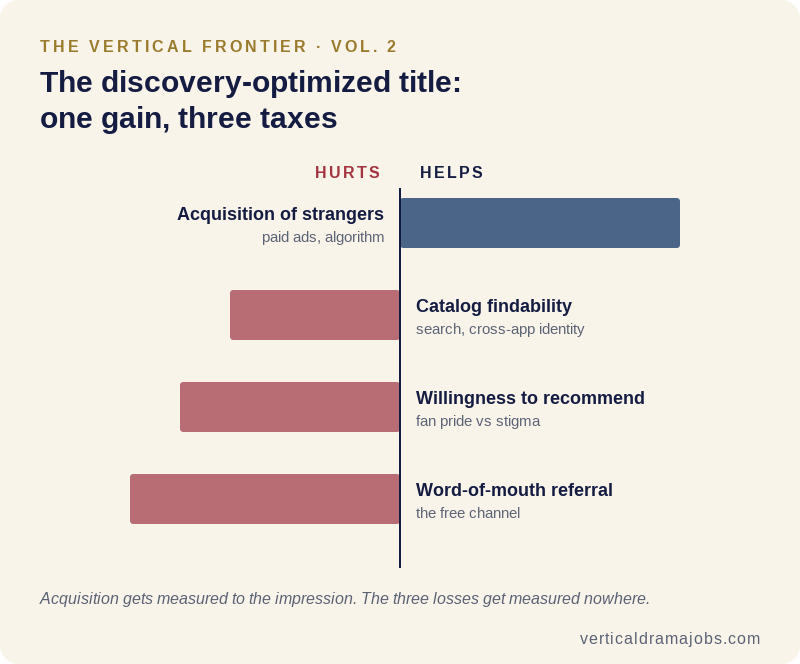 Figure: The discovery-optimized title buys one measured gain and three unmeasured losses. The industry optimizes the half of the ledger it can see. Directional estimate from the aggregate synthesis, not audited data.
Tax one: findability collapses
A devoted fan often can't relocate a show she loved. She can't tell whether a new release is genuinely new or a rename. And she can't point a friend to it, because there's no stable name to point to. Every retitle makes the catalog a little harder to search and a little less trustworthy as a list of distinct shows.
Tax two: the ads manufacture stigma
Trope-stacked titles and shock-cut ads are the only face of the medium that non-viewers ever see. They get the most extreme version of the format, built to grab strangers, and they judge the whole category on it.
Fans feel that judgment, so they learn to hide. Committed viewers describe concealing a habit they privately love. A fan survey of more than 1,600 Western viewers found a heavily female, habitually private audience (Vertical Drama Love survey, via Deadline, December 2025).
You see the same silence on the other side of the camera. TheWrap's January 2026 investigation documented performers distancing themselves from the medium's public reputation, including an actress who stepped back citing graphic content and rapid schedules. Performers keeping a public distance from work they're privately deep in is the same pattern, seen from production.
Tax three: word of mouth dies
A fan who can't find the show can't recommend it. A fan who's embarrassed by it won't. So a hidden fan refers nobody.
And word of mouth is the only free channel in the funnel. Every viewer who arrives through a friend is one the platform didn't have to pay for.
Why the industry can't see the cost
The machine feeds its most expensive acquisition channel, paid ads, by strangling its cheapest one, referral.
It does this invisibly. Acquisition gets measured to the impression. Referral, pride and findability get measured nowhere. A dashboard that only shows the gain will always say retitling works.
| What the retitled show produces | Is it measured? | Effect on the business |
|---|---|---|
| A click from a stranger | Yes, to the impression | A gain the team can see and optimize |
| A fan who can't find the show again | No | Lost repeat viewing |
| A fan who hides the habit | No | Lost pride and public presence |
| A recommendation that never happens | No | Lost free acquisition, replaced with paid |
The volume describes this as a blind spot with a dollar figure attached. The losses are real, but they never reach the screen where decisions get made. For how this industry's spend shows up in ad data, see what vertical drama ad spend tells you about the next growth market.
Is micro drama marketing hurting the industry?
It's hurting the part of the business that should be cheapest to grow. The ad style is very good at what it's measured on, which is stopping a stranger's scroll. It's bad at what happens after: keeping a fan, turning a fan into an advocate, and giving the medium a reputation people are comfortable sharing.
Platforms can keep testing titles and running hard-hitting ads. The problem is having nothing stable underneath them.
What is the fix for vertical drama retitling?
 Give every show a stable canonical identity underneath whatever discovery-facing titles the campaigns need.
Search marketing made this same split twenty years ago. The clickable headline changes per campaign. The durable brand doesn't. The headline does the acquiring and the brand does the remembering.
For vertical drama, a canonical identity would mean three things:
- Permanent names. One name per show that never changes, attached to every campaign title it has ever run under.
- Searchable people. Cast and creators listed and findable, so a fan can find a show through the actor she remembers.
- An aesthetic the audience isn't embarrassed by. A public face for the catalog that a fan would be comfortable sharing.
The first platform to do this opens a channel its competitors have been paying to suppress. It's rare for a finding to name a measurable problem and its cure together. The audience relationship that follows from searchable people is covered in vertical drama actors and the parasocial moat.
How to find a micro drama you watched
Until platforms build stable identities, viewers are on their own. A few habits help:
- Remember the lead actor, not just the title. Titles change but faces don't, so search for the performer.
- Note which app you watched it on. The same show can carry different titles on different apps.
- Screenshot the title screen and cast when you start a show you like. That's easier to search later than a half-remembered name.
- Check whether a "new" show is a rename. If the cast and the opening scene look familiar, you may have finished it already.
What this means for your career
Producers and platform staff
If you sit near marketing or catalog decisions, push for a canonical record for every show: one permanent name, every campaign title mapped to it, and full cast and creator credits. It costs little, and it's the kind of operational fix that gets noticed. Roles where this matters show up on producer jobs and studio jobs.
Actors
You're the most stable identity a show has. Fans remember your face even when titles change. Keep a public list of your credits with every title each show has run under, so fans who find you can find the work. That following is the asset that moves with you from platform to platform.
Editors and marketing crew
You cut the trailers and ad variants that create the first impression. You can make work that stops the scroll without making the fans who already love the show want to hide it. That skill is worth building, and worth talking about in interviews. See editor jobs for current openings.
Writers
Titles often change after you hand in a script. Keep your own record of your shows and their working titles, and ask the platform which titles a series runs under so your credits stay traceable.
Frequently asked questions
Why do vertical dramas have different titles on different apps?
Platforms retitle per app and per campaign to win clicks from new viewers. Nothing stable sits underneath, so one show can look like several.
How do I find a micro drama I watched but forgot the name of?
Search for the lead actor instead of the title, and check the app you watched it on. The cast stays the same even when the name doesn't.
Is a "new" vertical drama sometimes just an old one with a new title?
It can be. Fans report not being able to tell a new release from a rename.
Why are people embarrassed to watch micro dramas?
The ads and titles are the only face of the format most non-viewers see, and they're lurid. See the stigma section above.
Does word of mouth matter for micro drama apps?
Yes. Every viewer who arrives through a recommendation is one the platform didn't pay for.
What would fix micro drama discovery?
A stable canonical identity for every show, with the three pieces laid out above, underneath whatever titles the ads need.
The main apps and where they differ are covered in Micro Drama Summit's guide to microdrama apps and platforms.
More from The Vertical Frontier
- The Vertical Frontier, Volume Two: Where the money is hiding
- Micro drama unit economics: CAC, payback and cohorts
- Micro drama localization and AI dubbing: why proven titles are inventory
- Vertical drama creator data and pay transparency
- Who watches vertical drama? Audience demographics in 2026
- Vertical drama actors and the parasocial moat