How to Finance a Vertical Drama Series: Build the Capital Stack From the Cheap Money Up
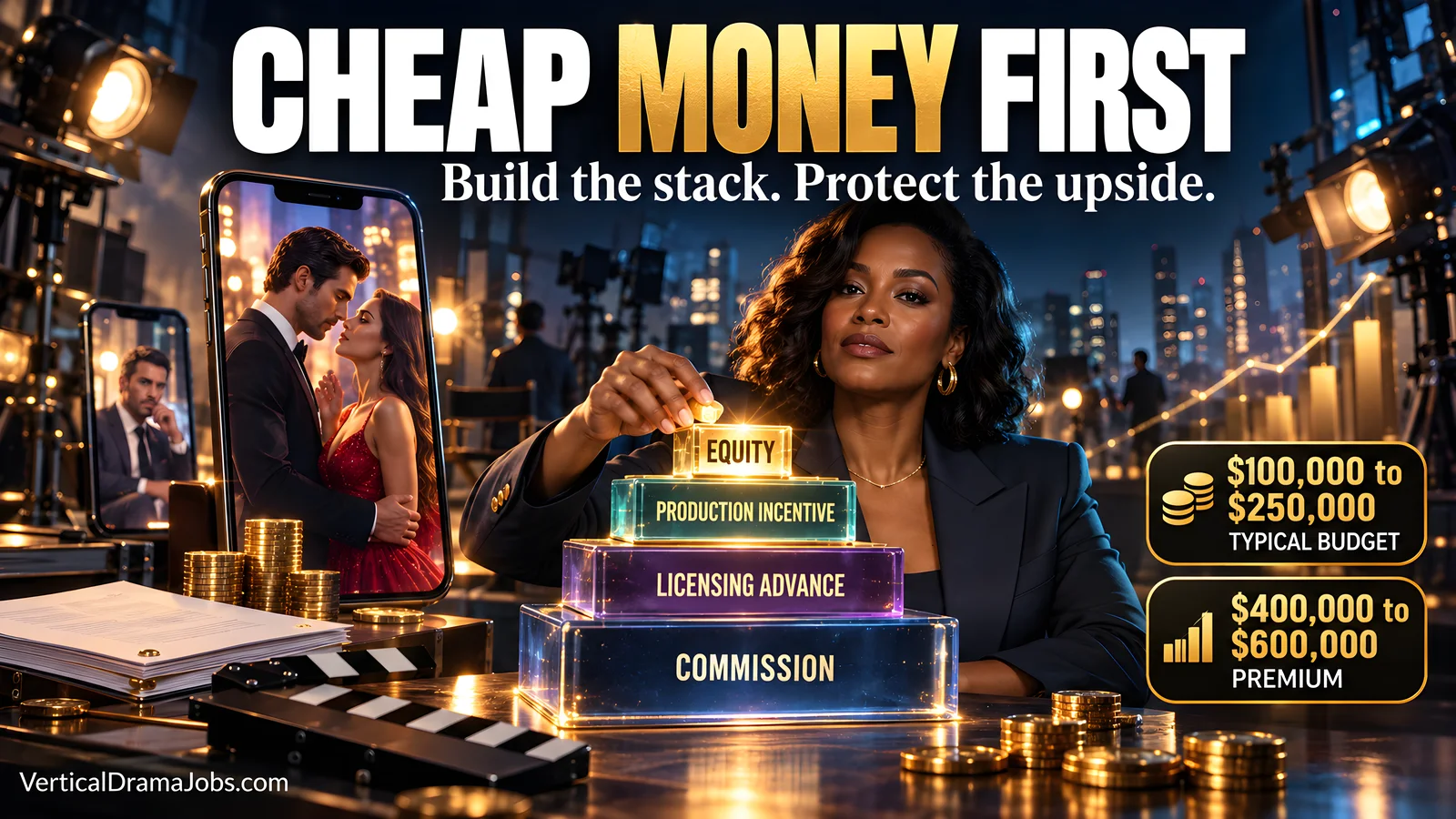
To finance a vertical drama series well, draw the cheapest money first: commissions, licensing advances and production incentives. Outside equity comes last, sized only to the gap the cheaper sources couldn't cover, because it's the most expensive money in the industry.
Most people asking how to fund a micro drama start with "who will invest?" Durable operators ask something else. How little of the budget has to touch equity at all?
This guide draws on The Vertical Frontier, Volume Two: Where the Money Is Hiding, an aggregate synthesis of first-hand industry discussions, structured interviews in five markets, independent audience research and outside industry data. It builds on Volume One, The Vertical Frontier: 8 Truths About the Microdrama Industry, which explains how the market works. This volume is about the moves.
Key takeaways
- The order matters more than the amount: commissions, licensing advances and incentives first, equity last.
- Cheap money arrives against a distribution commitment or a rebate. Nobody takes a share of your upside.
- Equity is the most expensive slice. It prices in every risk the earlier sources already retired, and it never stops taking a cut.
- Equity raised first signals a weak operation, because the cheaper sources should have carried most of the budget.
- Love Under Fire shows the licensing route at small scale. Its producer made it on a $100,000 budget and is pursuing a licensing sale, not a per-stream commission.
How do you fund a vertical drama series?
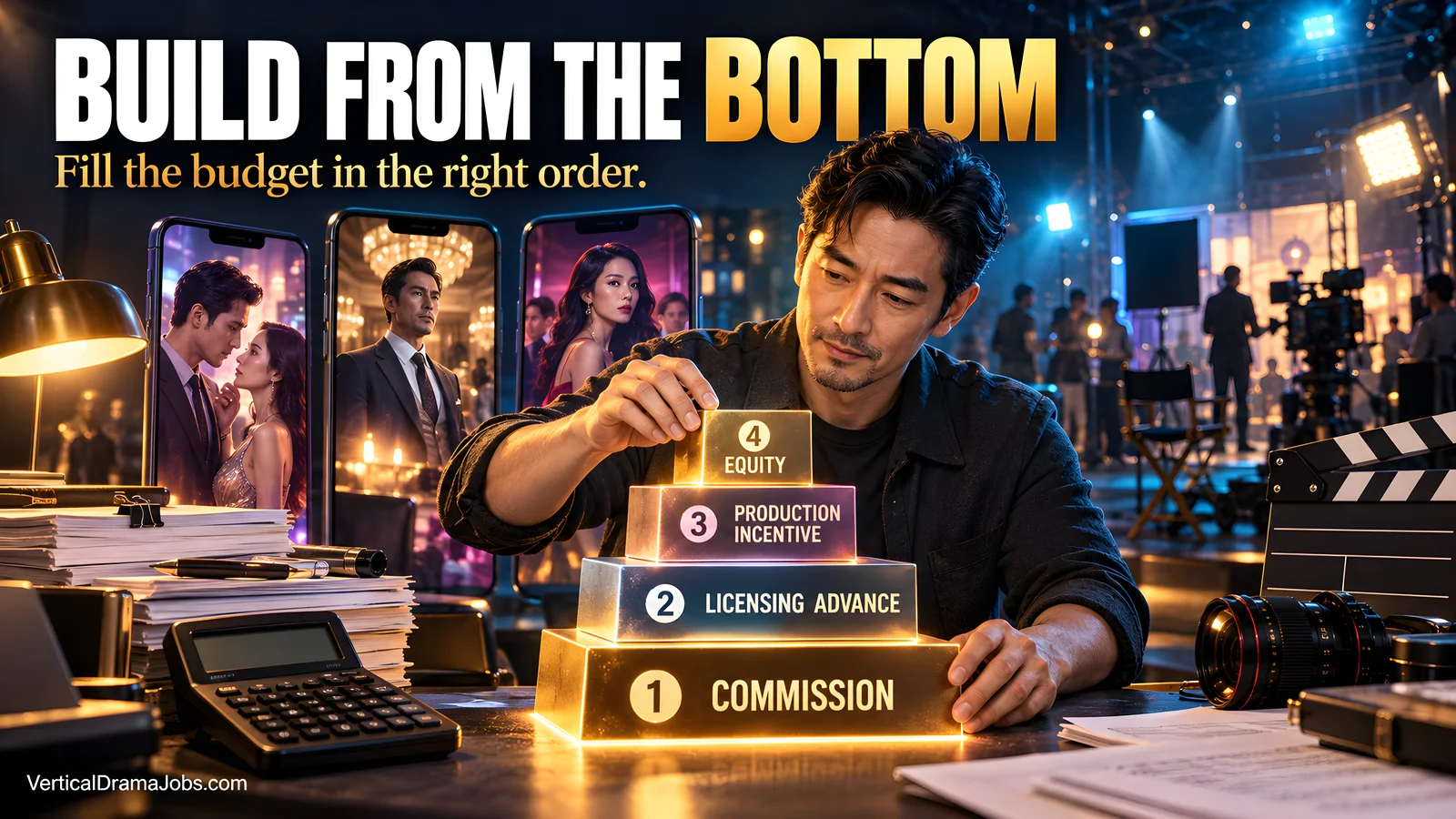 Ask how a slate gets funded and the obvious answer is investors. Watch how durable operators actually build a budget and you see a different order. They fill it from the bottom up:
- Commissions. A platform orders the show. That de-risks the title and any later raise.
- Licensing advances. A platform pays for the right to carry the show. Distribution interest turns into production capital.
- Production incentives. A jurisdiction's rebate lowers the cost basis before a single viewer is acquired.
- Equity. Outside investors fill whatever gap is left, and only that gap.
The first three share one trait. The money arrives against a distribution commitment or a rebate. That's what makes it cheap, since nobody providing it takes a permanent share of what the show earns later.
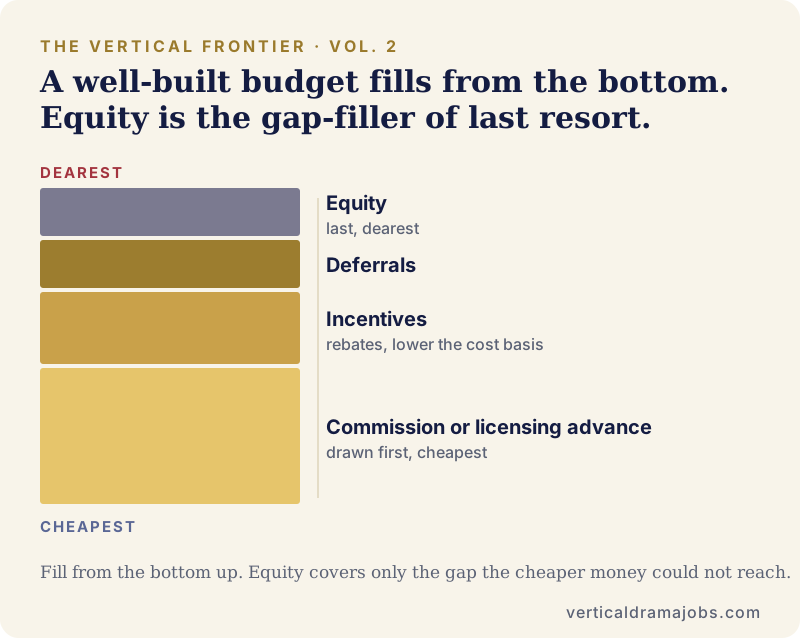 Figure: A well-built budget fills from the bottom up. Equity is the gap-filler of last resort, sized only to what the cheaper stack couldn't reach. Directional estimate from the aggregate synthesis, not audited data.
Where do deferrals fit?
Deferred fees sit between the cheap sources and equity in practice. They cover a gap without handing over ownership. But they aren't free. A deferral is money owed to people who already worked, and Volume One showed how much of this industry's low cost is carried by its workforce, in why vertical drama budgets are so low. Think of a deferral as a debt to your crew rather than a funding source.
How much does a vertical drama cost to make?
You need the size of the hole before you can fill it. US vertical drama budgets typically run $100,000 to $250,000, with premium productions reaching $400,000 to $600,000, according to Variety in November 2025, citing Media Partners Asia.
By film and TV standards those numbers are small, and that's why the order of the stack matters. On a budget this size, a commission or licensing advance can carry most or all of the cost, and equity may never need to enter the picture.
Spending more doesn't reliably earn more, either. The portfolio business guide has the detail.
Licensing vs commission in vertical drama: what is the difference?
The words get used loosely, so here's how we use them.
- A commission is a platform ordering a show. The platform wants it made, and that order lets everything else fall into place.
- A licensing deal is a platform paying for the right to carry a show. A licensing advance is that payment arriving early enough to fund production.
- A per-stream or revenue-share deal pays the producer a slice of what the show earns as people watch. The money comes later, if it comes.
The first two put money in the budget before cameras roll. The third asks the producer to fund the shoot from somewhere else and wait.
The Love Under Fire example
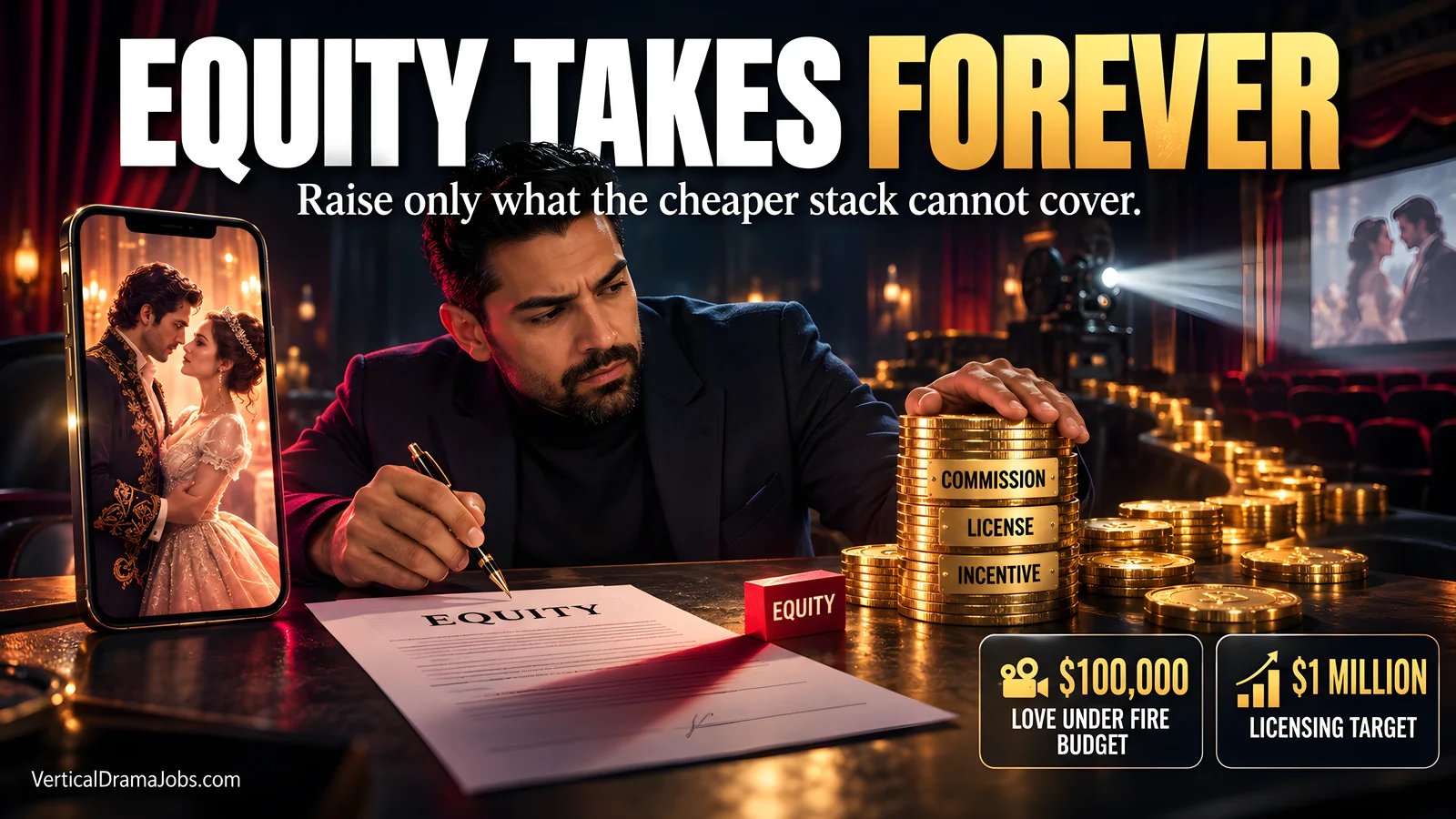
One recent production shows the licensing route. Kasey Esser stars in, wrote and produces Love Under Fire, a 60-minute independent microdrama made on a $100,000 budget, against the usual $150,000 to $250,000. The Ankler reported in September 2025 that he is pursuing a licensing deal and won't settle for less than $1 million. A target is not a result, and we haven't seen a reported sale price.
The plan is built around a licensing sale, so the sale is the payoff instead of a per-stream commission. Whether it closes is still open.
Why should equity come last in micro drama financing?
 It's the most expensive money in the industry, for two reasons.
Equity prices in every risk. An investor backing an unproven show is pricing the chance that nobody orders it, nobody licenses it and nobody watches it. Once a commission or licensing advance is in place, much of that risk is gone, so equity raised after those sources should cost less. Equity raised before them costs the most it ever will.
It also never stops taking a cut. A rebate is paid once. An advance is earned against. Equity holds a share of the upside for as long as the show earns. When one breakout title can carry a whole catalog, giving away a permanent share of a hit is the most expensive thing a producer can do.
So the funding question changes from "who will invest?" to "how little of this has to touch equity?"
Comparing the four sources of vertical drama funding
| Source | What it arrives against | What it costs you | When to draw it |
|---|---|---|---|
| Commission | A platform's order | Control shared with the commissioning platform | First |
| Licensing advance | A platform's right to carry the show | Rights for the licensed term | First |
| Production incentive | A jurisdiction's rebate | Meeting the program's rules | Early, it lowers the cost basis |
| Outside equity | A share of the upside | A permanent cut of what the show earns | Last, sized to the gap |
Terms vary from deal to deal, but the order holds.
What are the warning signs of an under-built vertical drama budget?
You can't spot an under-built budget by how little money it has. Look for equity raised first, ahead of the cheaper sources that should have carried most of the cost.
Look for these patterns:
- The pitch to investors comes before any platform conversation. The most expensive money is being asked to carry risk a commission could have retired.
- No one has checked for a production incentive. A rebate that lowers the cost basis is money left on the table.
- The plan relies on per-stream revenue to pay back investors. That puts the slowest money behind the most expensive money.
- Equity covers the whole budget. The team skipped the work of assembling the rest.
Operators who compound treat outside investment as a last resort. Each piece of the cheaper stack has a specific job. A commission de-risks the title and the raise, an incentive lowers the cost basis before a viewer is acquired, and a licensing advance turns distribution interest into production capital.
Does the capital stack change what gets made?
It changes who carries the risk, and that shapes decisions. When a commission or licensing advance covers the budget, the producer has to satisfy a platform before shooting. That matches how this market works. Volume Two finds that the greenlight lives on the demand side: whether a platform will feature a title and whether the hook stops the scroll can both be answered before production. The unit economics guide covers how operators test concepts before spending.
If a concept can't attract a commission or an advance, take that as information. Often the right move is to shelve it and test the next one rather than raise equity and hope.
What this means for your career
Money moves first in this business, and the people who understand how it moves get more done. The advice below follows from the finding.
Producers
Learn the stack before you learn the pitch. Before you approach a single investor, map every platform that might commission or license the project and every incentive the shoot location might offer. Write down the gap that's left. That number is your raise, and the full budget isn't. Producer jobs increasingly reward people who can build a budget this way.
Writers and showrunners
A project that arrives with a platform conversation already started is easier to finance than one with only a script. Learn which platforms buy which kinds of shows, and shape your pitch so a commission or license is a realistic first step. Volume One explains how writer pay works in the flat fee guide.
Directors
Directors who can deliver a show inside a fixed licensing budget, on schedule, become the people producers call when the advance lands. Reliability is part of the capital stack. Browse director jobs.
Actors and crew
Ask how a production is funded before you agree to defer anything. A project backed by a commission or licensing deal has money committed before the shoot. One that asks you to defer pay while it chases investors wants you to carry risk that should sit higher in the stack. For how pay works, see we need to talk about the money in micro drama.
Studio and platform staff
If you work on the platform side, you are the cheap money. Understanding how producers sequence their budgets helps you structure commissions and advances that get the right shows made. See studio jobs.
Frequently asked questions
How do I fund my first vertical drama series?
Start with the sources that don't take a share of the upside: a platform commission, a licensing advance and any incentive your shoot location offers. Work out the gap they leave, and raise equity only for that.
Should I go to investors first for a micro drama?
Usually not. Equity costs the most and keeps its cut for as long as the show earns. Raising it first is the clearest sign of an under-built budget.
What is the difference between licensing and a commission in vertical drama?
A commission is a platform ordering a show. A licensing deal is a platform paying to carry it. Both put money in the budget before shooting, unlike a per-stream deal that pays only as people watch.
Can a vertical drama be funded without investors?
Sometimes. Love Under Fire, described above, was made on $100,000 with a licensing sale as the plan, but The Ankler's September 2025 report describes producers and backers behind it, and no sale has been reported.
How much does a micro drama cost to produce?
Typically $100,000 to $250,000, and premium productions reach $400,000 to $600,000 (see the budget section above). At that size, cheaper sources can often carry most of the cost.
Are production incentives available for vertical dramas?
Often, yes, and they're one of the cheapest sources in the stack. Rules differ by location, so check the program where you plan to shoot before you budget.
Before you raise against a series, it helps to know where the revenue comes from. Micro Drama Summit explains it in how microdramas make money.
Sources and notes
- Love Under Fire, produced by Kasey Esser on a $100,000 budget, with a licensing deal of at least $1 million targeted: The Ankler, September 2025.
- US vertical drama budgets of $100,000 to $250,000, premium productions $400,000 to $600,000: Variety, November 2025, citing Media Partners Asia.
- Capital sequencing findings: The Vertical Frontier, Volume Two: Where the Money Is Hiding (2026), an aggregate synthesis. No finding is attributed to any individual contributor.
Figures are illustrative of the relationships described and are directional rather than audited.
More from The Vertical Frontier
- The Vertical Frontier, Volume Two: Where the Money Is Hiding
- Micro drama is a portfolio business: hit rate and budget vs return
- Micro drama unit economics: CAC, payback and cohorts
- How much it costs to dub a micro drama with AI
- AI animation and honest synthetics in vertical drama
- Why vertical drama budgets are so low (Volume One)
- Vertical drama writer flat fees explained (Volume One)